This is an old revision of the document!
Paris-Dakar Vehicle Modifications
The four Paris-Dakar Iltises were based on 1979 Bundeswehr-specification vehicles, sourced directly from Audi's main production plant in Ingolstadt, Germany. Each was subsequently modified to improve performance, enhance safety, and accommodate additional auxiliary equipment. These modifications were intended to prepare the vehicles for the demanding conditions of the rally while retaining the Iltis's proven design and mechanical simplicity.
Engine & Performance
Engine
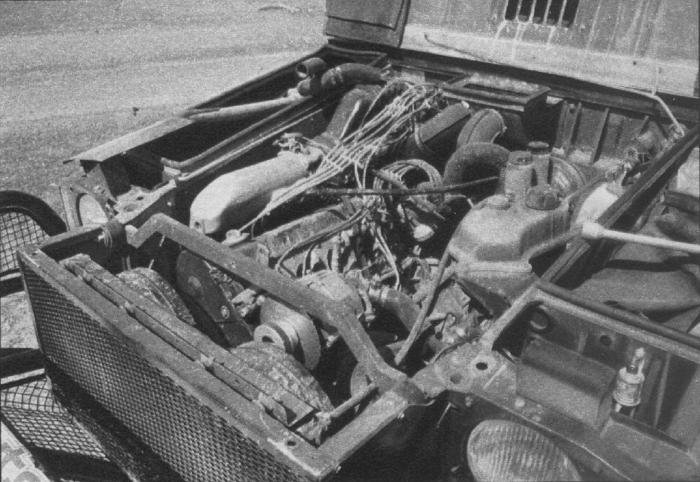
Iltis No. 138: 5-cylinder, 2.1-litre, Audi engine in an extended engine compartmentClick image to enlarge.
The most significant engine modification was made to Iltis No. 138, which received a complete engine transplant. Its original 1.7-litre engine was replaced with a naturally aspirated 2.1-litre (2,144 cc) inline-five found in the Audi 100 series. Equipped with Bosch K-Jetronic mechanical fuel injection, the engine was reportedly tuned to produce an estimated 150–160 hp. Accommodating the longer engine required extending the engine compartment, moving the radiator forward by approximately 20 cm and lengthening the hood.
The other three Iltises (No. 136, No. 137, and No. 139) retained their factory 1.7-litre gasoline engines, modified to produce an estimated 110 hp. These engines reportedly featured a larger, dual-barrel carburetor (likely a Zenith 32 NDIX from the DKW Munga) and a more aggressive camshaft and/or modified cylinder head to increase power.
Transmission and Rear Differential
All four Iltises retained their standard transmission gearing and rear differential. However, for Iltis No. 138, which produced more than 150 hp, the engineers decided to lock the transmission in four-wheel drive, believing that the increased power would make the vehicle difficult to control when driven on a single axle. Jean Ragnotti, the driver of Iltis No. 138, who had extensive experience in rear-wheel-drive rally cars, later expressed regret over this decision, as it limited his ability to use the throttle to help rotate the car through corners.
Fuel
A second, backup fuel pump was installed and could be manually activated by the driver.
Intake
All four Iltises were fitted with a hood scoop, essentially a forward-facing metal box mounted over the louvers at the rear of the hood. The scoop on Iltis No. 137 was lost or removed very early in the rally, while the other three vehicles retained theirs for the duration of the race. The original green paint on No. 137's hood still reveals the outline of the scoop's mounting position. Very few photographs show the scoop in place, and all of them were taken before the rally began.
Exhaust
The exhaust pipe was shortened to exit on the passenger side, just ahead of the rear wheel. A full-length exhaust system was unnecessary, while the shorter pipe reduced the risk of snagging on obstacles during the rally.
Brakes
The braking system remained in factory specification, with no reported modifications to the brakes to compensate for the increased engine output. Reportedly, this was particularly significant for Iltis No. 138 with nearly twice the horsepower of a stock Iltis.
Safety & Ruggedness
Several safety and reinforcement modifications were carried out by German/French roll cage specialist Matter Motorsports, including the front bumper, roll bar extension, and racing harnesses. These modifications helped prepare the vehicles and their crews for the punishing terrain and demanding conditions of the rally.
Front Bumper
The most noticeable exterior modification was the replacement of the factory front bumper on all four vehicles with a purpose-built brush guard. Constructed from aluminum tubing and metal mesh and finished in black, the guard protected the radiator and headlights from damage. Its design also improved the approach angle and helped reduce the risk of the vehicle overturning when landing nose-first after a jump.
Roll Bar Extension
The factory aluminum roll bar was extended forward to the A-pillars, creating a structure that effectively served as a roll cage. A tube extended from the top of each B-pillar, bending downward toward the footwell, where it was bolted to the body and frame. The tops of the two A-pillars were then joined by a third section running across the top of the windshield.
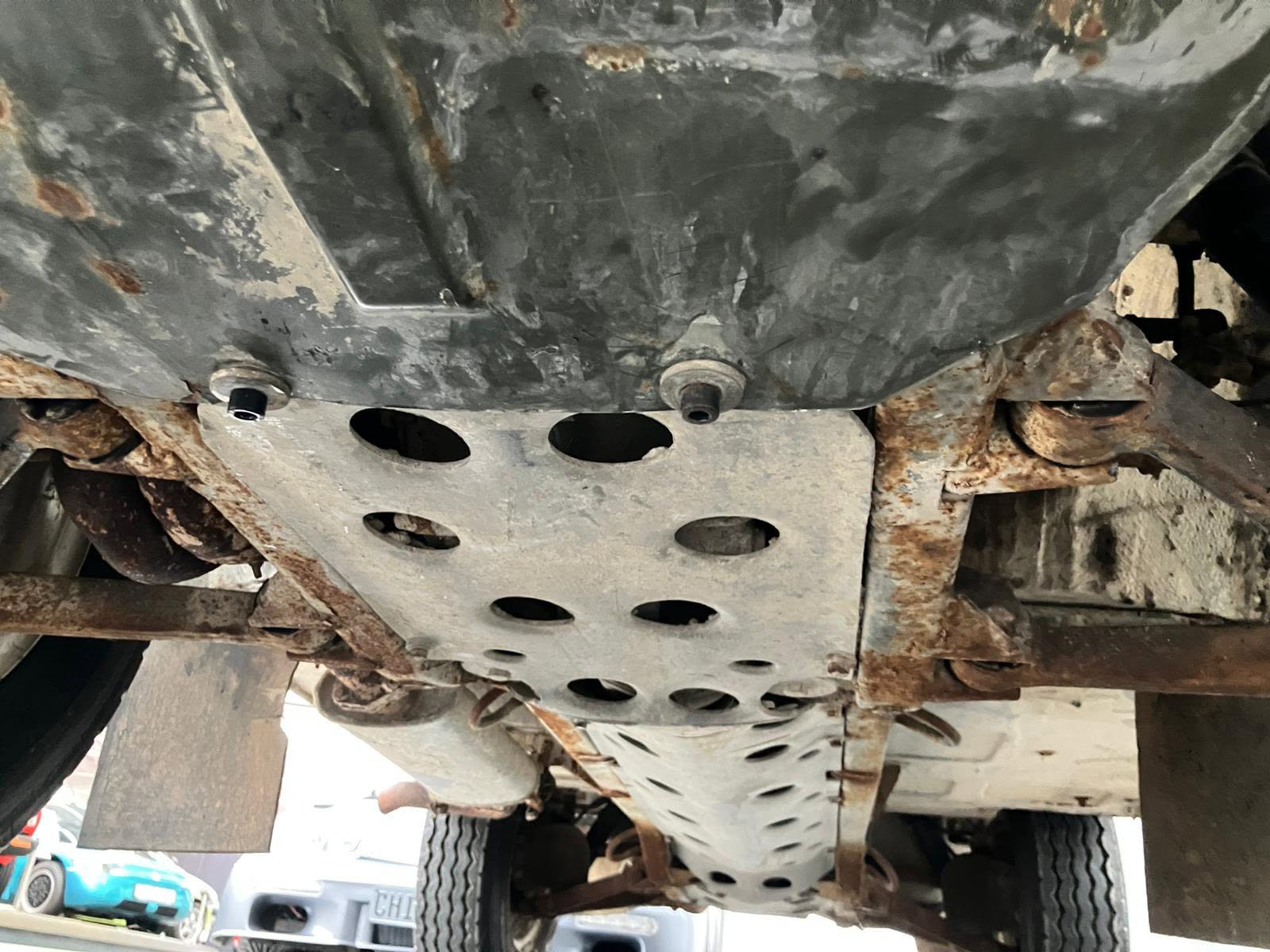
Iltis No. 137: Underside protection platesClick image to enlarge.
Underside Protection
In addition to the factory steel engine protection plates, three aluminum skid plates were fitted, spanning the length of the frame rails to protect the transaxle, propeller shaft, and rear differential. Additional aluminum plates were added behind the rear differential to protect from impacts and damage on rough terrain.
Racing Harnesses
The factory seatbelts were replaced with three-point racing harnesses for both the driver and co-driver. The harnesses were bright red and featured the “Matter” branding, suggesting they may have been manufactured by another supplier and rebranded by Matter Motorsports, which was responsible for several of the Iltises' safety modifications.
Electrical Kill Switch
An emergency electrical cutoff switch was mounted on the driver's-side cowl, just ahead of the windshield. Its location was marked by a standard blue triangle decal featuring a lightning bolt.
Hood Pins
Two hood pins were installed at the front of the hood to help keep it securely fastened during the rally.
Auxiliary Equipment
Mud Flaps
Wide mud flaps were fitted to both the front and rear wheels.
Rally Lights
Additional rally lights were fitted to improve visibility during night driving and in poor weather conditions. The two French vehicle teams (No. 136 and No. 138) used lights from French manufacturer S.E.V. Marchal. The two German vehicle teams (No. 137 and No. 139) used lights from German manufacturer BOSCH.
The following are the rally light configurations on each vehicle:
- Iltis No. 136:
- two S.E.V. Marchal, 180 mm (7 inch), round lights (with white covers) on each side of the cowel, and
- two S.E.V. Marchal, 180 mm (7 inch), round lights (with white covers) on each side and below the brush gaurd.
- Iltis No. 137:
- two BOSCH, 180 mm (7 inch), round lights (with black covers) on each side of the cowel.
- Iltis No. 138:
- two S.E.V. Marchal, 180 mm (7 inch), round lights (with white covers) on each side of the cowel, and
- two S.E.V. Marchal, 180 mm (7 inch), round lights (with white covers) on each side and below the brush gaurd.
- Iltis No. 139:
- two retangular lights with black grills on each side of the cowel, and
- two BOSCH, 180 mm (7 inch), round lights (with black covers) on each side of the cowel, inside the rectangle lights.
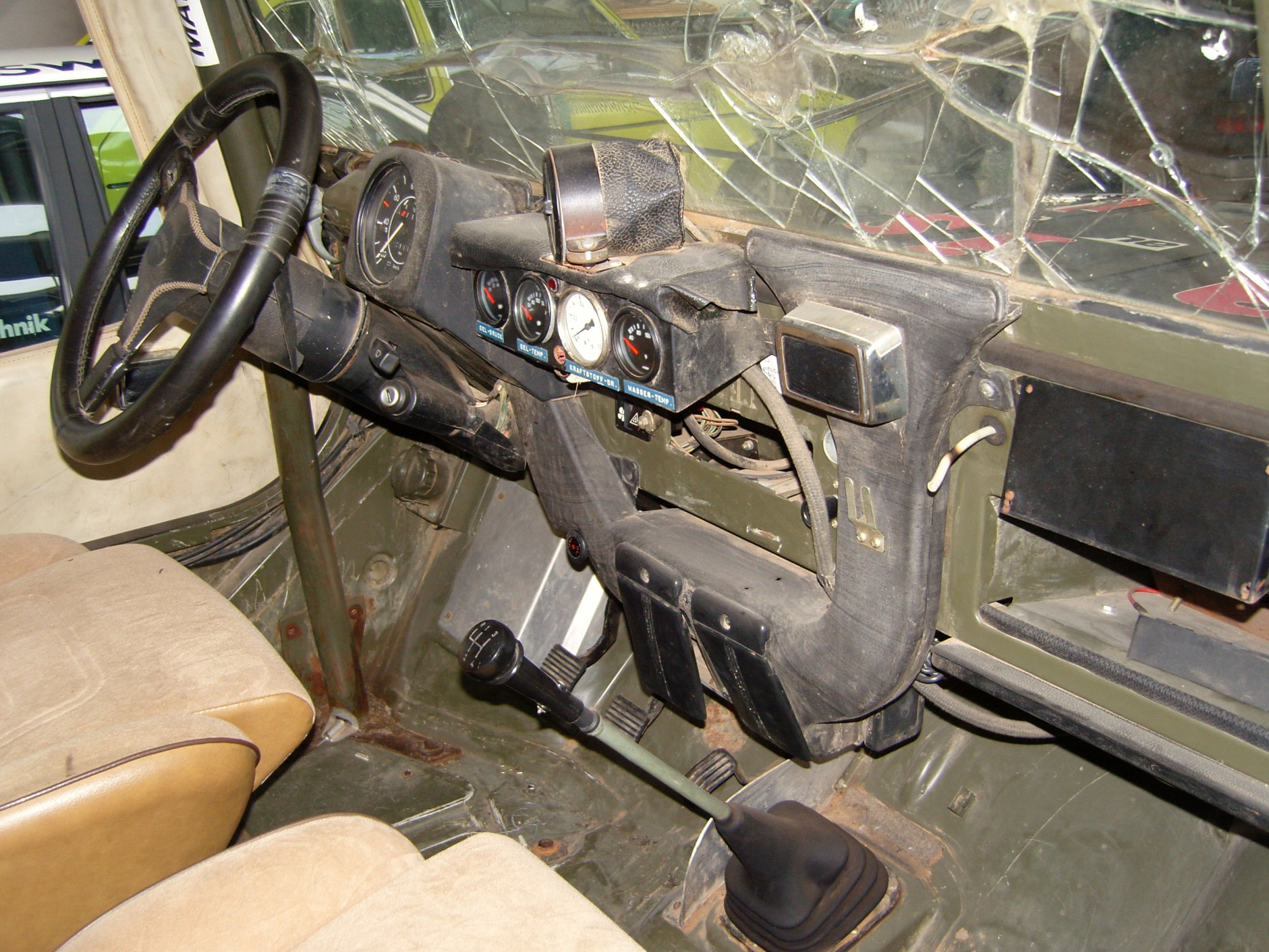
Iltis No. 137: Dash, as is now, with some equipment removed.Click image to enlarge.
Interior
Likely present on some or all four Iltises, the following modifications are confirmed to have been made to Iltis No. 137:
Steering Wheel — A three-spoke, leather wrapped, black Italvolanti Formel Indianapolis steering wheel was fitted.
Instrument Gauges — The three factory gauges were removed, leaving the original speedometer in place. A new instrument panel was installed to accommodate four additional gauges, with a separate pod housing the tachometer mounted on top.
| Tachometer | VDO | 400–7,000 rpm | |
| Oil Pressure | VDO | 0–10 bar | Labelled: “OEL-DRUCK” |
| Oil Temperature | VDO | 50–150 °C | Labelled: “OEL-TEMP.” |
| Fuel Pressure | EMVO | 0–1 bar | Labelled: “KRAFTSTOFF-DR.” |
| Water Temperature | VDO | 40–120 °C | Labelled: “WASSER-TEMP.” |
| Red Indicator Light | Unknown use. See More Information Needed. | ||
To the left of the steering wheel:
| Red Indicator Light | At top left of fuse panel. Unknown use. See More Information Needed. | |
| Fuel Pump Switch | Used to activate/deactivate the second, backup, fuel pump. | Labelled: “2. KRAFTSTOFFPUMPE” |
| Rally Lights Switch | Used to activate/deactivate the rally lights. | Labelled: “FERNSCHEINW.” |
Footwell Additions — An aluminum plate “dead pedal” was added for the driver's left foot, and a vertical aluminum plate was added to the right of the gas pedal to aid the driver in foot placement.
Storage Compartment — To the left of the driver's seat, and to the right of the co-driver's seat, an open-top metal box was installed and used as a general purpose storage compartment.
Ash Tray — Curiously, an ash tray was installed directly onto the plastic windshield defrost duct.
Rally computer(s) and radio(s) — Directly in front of the co-driver was mounted a rally equipment and communications radio. Details are unknown. See More Information Needed.
More Information Needed
Seats
The exact origin of the seats remains unknown. The tan-coloured upholstery fabric and pattern are consistent with those used in late-1970s Audi models, while the seatbacks resemble those fitted to civilian Iltises, featuring integrated headrests and black plastic rear panels. However, the large side bolsters on the seat cushions differ from both of these designs, making a definitive identification difficult.
Electrical
As 1979 Bundeswehr-specification vehicles, the Iltises would originally have been equipped with 24-volt electrical systems. However, some of the additional rally equipment, including radios, auxiliary gauges, and rally lights, may have required 12-volt power. How this difference was accommodated remains uncertain. One possibility is that a voltage converter or separate 12-volt supply circuit was installed to power the additional equipment. Alternatively, the original 24-volt electrical system may have been replaced or extensively adapted to use the 12-volt system found in civilian Iltis models.
Indicator Lights
Two red indicator lights are on the dash of Iltis No. 137 — one at the top left of the fuse panel, and one on the gauge pod. The use of either is unknown.
Suspension
Reports suggest that the Iltises' suspension was reinforced with modified, stiffer shock absorbers, although this has yet to be confirmed.
Fuel
90-liter reserve fuel tank???
Exhaust
was the exhaust larger