This is an old revision of the document!
2nd Paris-Dakar Oasis-Rally
“2ème Rallye Oasis de Paris a Dakar”
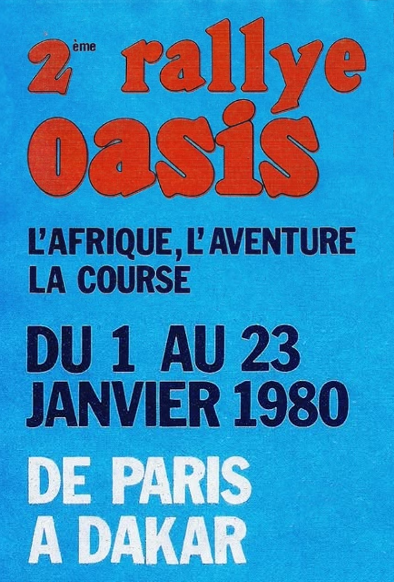
2nd Oasis Rally
Africa, the Adventure, the Race
January 1–23, 1980
From Paris to Dakar
- January 1st - January 23rd, 1980
- Crossed countries: France, Algeria, Mali, Mauritania, Niger, Upper Volta, Senegal
Starting at the Trocadéro in Paris, the rally crossed the Mediterranean to Algiers, and pushed through the African desert to arrive at Rose Lake in Dakar.
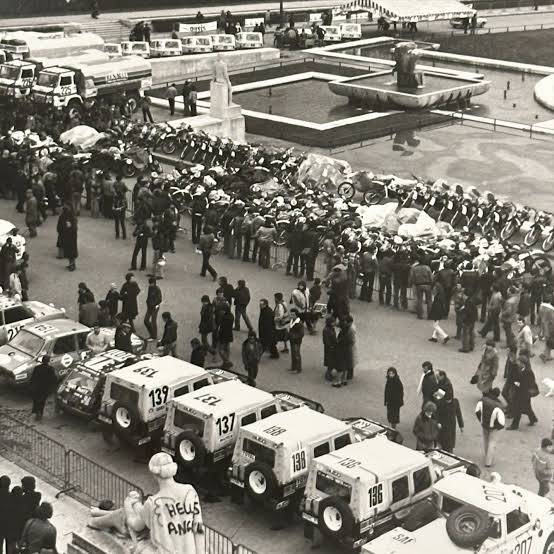 Iltises lined up at the Trocadéro in Paris, January 1st, 1980. Go to this location on Google Maps Street View...
Competitors
Class: Cars
| Manufacturer | Started | Finished | Attrition |
|---|---|---|---|
 AMC | 1 | 0 | 100% |
| Buggy | 3 | 2 | 33% |
 Citroën | 8 | 0 | 100% |
 Cournil | 4 | 3 | 25% |
 Daihatsu | 1 | 0 | 100% |
 Jeep | 3 | 0 | 100% |
 Lada | 8 | 3 | 63% |
 Land Rover | 27 | 16 | 41% |
 Mercedes-Benz | 1 | 1 | 0% |
 Peugeot | 9 | 1 | 89% |
 Renault | 6 | 1 | 83% |
 Sbarro | 1 | 0 | 100% |
 Toyota | 32 | 20 | 38% |
 Volkswagen | 4 | 4 | 0% |
| Others | 6 | 0 | 100% |
| All Cars | 116 | 49 | 58% |
Of the 216 competition vehicles that started in Paris, only about one third (81) crossed the finish line in Dakar.
Different than the inaugural rally in 1979, the 1980 rally categorized the vehicles into three classes: Bikes (“Motocyclettes”), Cars (“Autos”), and Trucks (“Camions”).
Class: Bikes
| Manufacturer | Started | Finished | Attrition |
|---|---|---|---|
 BMW | 3 | 1 | 67% |
 Ducati | 1 | 1 | 0% |
 Honda | 15 | 7 | 53% |
 Kawasaki | 5 | 2 | 60% |
 KTM | 2 | 2 | 0% |
 MZ | 1 | 0 | 100% |
| Side | 2 | 0 | 100% |
 Suzuki | 7 | 3 | 57% |
 Vespa | 4 | 2 | 50% |
 Yamaha | 46 | 13 | 72% |
| Others | 4 | 0 | 100% |
| All Bikes | 90 | 25 | 72% |
Class: Trucks
| Manufacturer | Started | Finished | Attrition |
|---|---|---|---|
 Leyland | 1 | 1 | 0% |
 MAN | 2 | 1 | 50% |
| Mercedes-Benz | 2 | 0 | 100% |
| Renault | 2 | 2 | 0% |
 Sonacome | 3 | 3 | 0% |
| All Trucks | 10 | 7 | 30% |
Schedule / Route
The rally consisted of seven stages which included 13 special stages (“spéciales”). The rally covered more than 10,000 km with 4,059 km in the special stages.
Standings
Class: Bikes (Top 10)
| Place | Time | Rider | No. | Vehicle |
|---|---|---|---|---|
| 1st | 48:03:— |  Cyril Neveu | 50 | Yamaha XT 500 |
| 2nd | 48:19:— | Michel Merel | 58 | Yamaha XT 500 |
| 3rd | 48:43:— | Jean-Noël Pineau | 60 | Yamaha XT 500 |
| 4th | — | Jean-Pierre Lloret | 80 | Yamaha XT 500 |
| 5th | — | “Fenouil” (Jean-Claude Morellet) | 86 | BMW 800 |
| 6th | — | Philippe Vassard | 43 | KTM 240 |
| 7th | — |  Alain Padou | 38 | Honda XR 500 |
| 8th | — | Ludovic Loue | 48 | Yamaha XT 500 |
| 9th | — | Guy Albaret | 74 | Yamaha XT 500 |
| 10th | — | Marc Joineau | 22 | Suzuki SP 370 |
Class: Cars (Top 10)
| Place | Time | Driver, Co-driver(s) | No. | Vehicle | ||
|---|---|---|---|---|---|---|
| 1st | 55:14:28 |  Freddy Kottulinsky | Gerd Löffelman | 137 | Volkswagen Iltis |
|
| 2nd | 55:28:14 | Patrick Zaniroli | Philippe Colesse | 136 | Volkswagen Iltis |
|
| 3rd | 57:38:55 | Claude Marreau | Bernard Marreau | 120 | Renault 4 Sinpar |
|
| 4th | — | Jean Ragnotti | Georges Vaills | 138 | Volkswagen Iltis |
|
| 5th | — | Claude Neveu | Jean-Paul Auborg | 179 | Range Rover V8 |
|
| 6th | — | Claude Bourgoignie | Jean-Pierre Tasiaux | Maurice Gierst | 176 | Range Rover V8 |
| 7th | — | Christine Beckers | Thierry Gérin | Marc Stinglhamber | 177 | Range Rover V8 |
| 8th | — | Jacques Delefortrie | Pierre Delefortrie | Patrick Prat | 157 | Toyota BJ43 |
| 9th | — | Roland Gumpert | Eder Alois | 139 | Volkswagen Iltis |
|
| 10th | — | Claude Germonprez | Jean-Claude Ravez | 188 | Range Rover V8 |
|
Class: Trucks (Top 7)
| Place | Time | Driver, Co-driver, Technician | No. | Vehicle | ||
|---|---|---|---|---|---|---|
| 1st | 72:03:47 |  Miloud Ataouat | Hadj Daou Boukrif | Mahiedine Kaoula | 228 | Sonacome M210 |
| 2nd | 72:49:47 | Bernard Heu | Daniel Delobel | Gilbert Versino | 223 | MAN 20.280 |
| 3rd | 72:57:16 | Abdelkader Bouzid | Daid | Mekhelef | 229 | Sonacome M210 |
| 4th | 80:40:46 | Mouhamed Affane | Bouhafs Zergoune | Lakhdar Haddou | 227 | Sonacome M210 |
| 5th | 89:44:55 | Jean-Claude Marie | Cyril Boulay | 225 | Renault SM8 |
|
| 6th | 91:13:49 | Jacques Frumholtz | Francis Doz | 226 | Renault SM8 |
|
| 7th | 98:18:22 | René Metge | Thierry De Saulieu | Georges Landais | 230 | Leyland Marathon |
Volkswagen Team Vehicles
 Volkswagen Team Iltises. Left to right - No. 139 Iltis: Eder Alois, Roland Gumpert. No. 137 Iltis: Gerd Löffelman, Freddy Kottulinsky. No. 138 Iltis: Georges Vaills, Jean Ragnotti. No. 136 Iltis: Philippe Colesse, Patrick Zaniroli.
All four Volkswagen Iltises successfully completed the rally, finishing first, second, forth, and ninth out of the 116 cars competing. The Volkswagen Team support truck finished second in its class.
Two German and two French teams. Germany was trying to convince the French army to replace their aging Mungas with Iltis as they had in the German army. The rally was a French rally.
A rule that still stands today prohibits the vehicles are not allowed to be serviced by outside personnel, however competitors can work on their own cars - or help others. So Volkswagen decided to have Gumpert pilot one of the Iltises (#139) with an experienced mechanic (Eder) as a copilot. That Iltis carried about 300 kg of spare parts.
Dakar Models Collection has a very nice, detailed 1:43 models of the Volkswagen team vehicles on YouTube.
As an aside, the Iltis vehicles were delivered to France in a khaki-green military color just days before the start of the Dakar. It was impossible to set off in that military livery, as it risked causing issues at border crossings—and the regulations explicitly prohibited that color. Consequently, the cars were painted black—using paint rollers—shortly before the start!
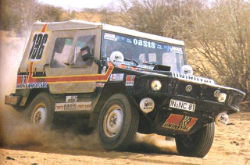
No. 136: Zaniroli / Colesse
| No. 136: Volkswagen Iltis |
|
|---|---|
| Driver | Patrick Zaniroli |
| Co-driver | Philippe Colesse |
| Plate | IN NC 81 |
| Finished | 2nd (Cars) |
The No. 136 Volkswagen Iltis was driven by Patrick Zaniroli of France, and co-driven by Philippe Colesse of France. They finished 2nd in the “Cars” class.
Their 1.7 litre, gasoline engine was tuned to approximated 110 hp using a larger carburetor and a more agressive camshaft.
The Iltis is still owned by Zaniroli and restored around 2005.
Dakar Models Collection has a very nice, detailed 1:43 model of this Iltis on YouTube.
No. 137: Kottulinsky / Löffelman
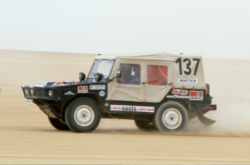
| No. 137: Volkswagen Iltis |
|
|---|---|
| Driver | Freddy Kottulinsky |
| Co-driver | Gerd Löffelman |
| Plate | IN NN 69 |
| Finished | 1st (Cars) |
The No. 137 Volkswagen Iltis was driven by Freddy Kottulinsky of Germany/Sweden, and co-driven by Gerd Löffelman of Germany. They finished 1st in the “Cars” class.
When asked for the first time to drive one of three cars that were supposed to support Jean Ragnotti, Kottulinsky, who had neither experience nor desire to race in a desert, declined indirectly by asking for a high salary. Shortly before the race began, the team hired him anyway, and Kottulinsky entered the race with hardly any preparation. He did not have a tent nor sleeping bag, but enough spare parts to keep the car running without having to wait for support. - Wikipedia
Their Iltis was powered by a factory 1.7 litre, gasoline engine and was tuned to approximated 110 hp using a larger carburetor and a more agressive camshaft.
This winning Iltis is often on display in the Volkswagen AutoMuseum / Autostadt complex in Wolfsburg.
Dakar Models Collection has a very nice, detailed 1:43 model of this Iltis on YouTube. A very accurate 1:43 model is available from Norev.
No. 138: Ragnotti / Vaills
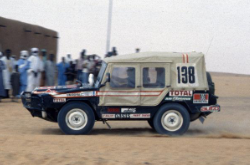
| No. 138: Volkswagen Iltis |
|
|---|---|
| Driver | Jean Ragnotti |
| Co-driver | Georges Vaills |
| Plate | IN NN 95 |
| Finished | 4th (Cars) |
The No. 138 Volkswagen Iltis was driven by Jean Ragnotti of France, and co-driven by Georges Vaills of France. They finished 4th in the “Cars” class.
Instead of the factory 1.7 litre engine, a naturally aspirated 2.1-liter (2,144 cc) inline-5 engine was installed, specifically derived from the Audi “5E” production power plant. With mechanical Bosch K-Jetronic fuel injection, this engine was tuned to an estimated 150-160 hp. To accommodate the longer engine, the engine compartment was lengthened by moving the radiator forward by about 20 cm and extending the hood which included an air scoop.
Dakar Models Collection has a very nice, detailed 1:43 model of this Iltis on YouTube.
- someone loosened wheel nuts (while in “parc fermé”) and it lost a wheel in the next stage, damaging suspension. After waiting for the service vehicle they fell back to 100th place - but then later finished 4th.
- To add to Seb's information, the chassis and suspension of the prototypes entered in 1980 were completely stock. The only slight difference was that the engine compartment had to be extended forward to accommodate the 2.2-liter, 150hp Audi 5-cylinder engine (well done, Seb!). The transmission was locked in 4WD, without using a center differential (the engineers thought the car would be undrivable with 150hp on a single axle, but Ragnotti regretted this solution as he couldn't use the car as he wanted in the corners). The top speed reached 160 km/h, which was already very fast at the time! Its weaknesses were its weight (1600kg with a full tank), the suspension, and the brakes; despite adjustments to the transverse leaf springs and the addition of suitable shock absorbers, the Iltis bounced a lot. During the rally, the stock of shock absorbers carried by the large MAN support truck was used up very quickly, and the end of the rally passed without any changes or improvements to the suspension. Finally, the original braking system was retained. It was designed for the original 75 hp, but since the Dakar Iltis engine had twice that power, the drivers had quite a few close calls!
No. 139: Gumpert / Alois
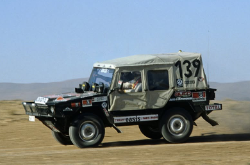
| No. 139: Volkswagen Iltis |
|
|---|---|
| Driver | Roland Gumpert |
| Co-driver | Eder Alois |
| Plate | IN NT 25 |
| Finished | 9th (Cars) |
The No. 139 Volkswagen Iltis was driven by Roland Gumpert of Germany, and co-driven by Eder Alois of Germany. They finished 9th in the “Cars” class.
Their 1.7 litre, gasoline engine was tuned to approximated 110 hp using a larger carburetor and a more agressive camshaft.
Dakar Models Collection has a very nice, detailed 1:43 model of this Iltis on YouTube.
- A rock smashed rear differential and driveshafts. He removed the rear diff, axles and prop shaft and continued as a front-wheel drive. A second incident involved another rock breaking the front left axle shaft. He then removed that axle as well, locked the front diff and finished the remaining 250 km with one-wheel drive.
No. 223: Heu / Delobel / Versino
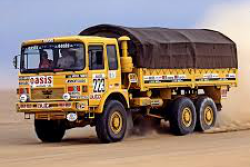
| No. 223: MAN 20.280 |
|
|---|---|
| Driver/ Co-drivers | Bernard Heu |
| Daniel Delobel |
|
| Gilbert Versino |
|
| Plate | 684 Z-9500 |
| Finished | 2nd (Trucks) |
The No. 223 MAN 20.280 truck was (co-)driven by Bernard Heu of France, Daniel Delobel of France, and Gilbert Versino of France. They finished 2nd in the “Trucks” class.
This truck and personnel served as support to the Volkswagen Iltises.
Dakar Models Collection has a very nice, detailed 1:43 model of this MAN 20.280 on YouTube.
Volkswagen Iltis Press Car
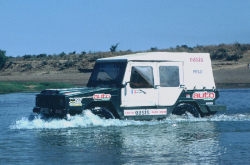
| Press Car: Volkswagen Iltis |
|
|---|---|
| Driver | Michel Guégan |
| Co-driver(s) | Reinhard Klein |
| François Beau |
|
| Plate | IN NR 91 |
Volkswagen supplied and supported an Iltis to be used as a press car that travelled along with the competitors. It was driven by Michel Guégan, a journalist, writer, and photographer for Auto Verte, with Reinhard Klein, an independent, freelance motorsport photographer and journalist, as co-driver. At some point before Bamako, Klein returned to Germany and François Beau, a motorsport photographer, hitched a ride from Kolokani onward.
François participated in the 1979 Dakar Rally as a competitor, driving a Pinzgauer alongside the late Jeff Dunac and Jean-Pierre Chapel (a shout-out to Michelle, by the way), and then in the following three rallies as a photographer for a press agency.
When the Dakardantan website was launched over 20 years ago (ouch!), he was one of the first official photographers to share his unpublished photos on the site. Since then, many have joined him (Michel Maindru, Didier Coste, Etienne Batifoulier, JP Boulmé, Hans Molenkamp, Bernard Mottuel, and many others), but at the time, his gesture particularly touched us.
He was even kind enough to share with us an account of his adventures in 1980, during the second edition of the rally, which he covered as a photographer for an agency… A different way to experience the Dakar, but above all, a pure delight!
I'm republishing this text, which takes us back 45 years and shows us the rally in a completely different light… A rather long account, but one that perfectly illustrates the difficulties that pile up day after day and somewhat “demystify” the idea one might have of this profession!
“I was lucky enough to follow the first four Dakar rallies. The most amateurish. The most enjoyable.
Those that could be followed entirely by road, taking the same route as the competitors. The first one even sometimes allowed for a bit of sightseeing, upon arriving at the stage.
But I didn't follow them as a competitor, except for the first one, but as a photographer for an agency that, unfortunately, at that time, didn't want to invest the resources to cover this new event, unsure of what they were getting themselves into, but also without considering the hardships they would put their photographer through. As soon as the first edition was over, they should have realized the importance of the event.
The The first one (not the one I'm going to talk about) was done as a competitor, in a Pinzgauer with Jean Pierre Chapel and Jean François Dunac, who worked for Auto-Moto magazine. It was a blast. Tiring, but a nice drive…
I'm going to talk about the second one, a real nightmare, the kind you rarely experience.
Many competitors had a lot of hardships. It was talked about a lot, but no one asked if they were the only ones. Thierry Sabine, whom we had gone to see before the event with the articles published during the previous Dakar Rally, had promised the agency photographer a place in a vehicle, because of the publicity it would generate for him.
So, full of confidence, I showed up in front of the Trocadero on the morning of the start to see the vehicle that had been assigned to me, or, more precisely, the vehicle in which I had a reserved seat.
Thierry then led me to a doctor's Toyota, short chassis, packed to the brim, and… He said, “You’ll find a place in there.”
The two doctors looked at each other, told me they had absolutely no room, but that I could sit, if I wanted, in the middle, between the two seats, knowing full well I wouldn’t go… An impossible solution. So I found myself in a sedan belonging to the organization, a road car, which was supposed to follow the caravan to the ferry in Sète. Nothing special, as dull as could be. We drove part of the night in the snow; having left last, we went through Bordeaux and boarded in Sète. During the crossing, sensing trouble ahead, I met the driver of the support vehicle, a long-wheelbase Land Rover, and asked him if he could give me a lift. He agreed; I would follow in the support vehicle.
Formalities in Algiers, and departure south. We began the climb to the plateau and started to smell an unpleasant odor of Diesel. Windows open, we continue south. Thankfully, the smell disappears quickly! I don't remember where we spent the night. There are three of us in the car, and everything seems fine. Which was just as well, since there are only three seats in the front, the back seats having been removed to transport all sorts of equipment.
We arrive in In Salah, where we spend the night in the hollow of a huge, semicircular dune.
Magnificent, the whole campsite with its lights in the center. We leave last the next day, which is normal since we're “the sweep,” after the car has taken Thierry Sabine to the airport. So we leave quite late for Reggane. After thirty kilometers, we see a Swiss man's Sbarro, completely wrecked, in the middle of the track, after it has rolled about ten times.
All the equipment is scattered over two hundred square meters: a spare gearbox, parts of all kinds. The car He drove over a small bump, and since he must have been driving like a maniac, he rolled over.
One of the passengers, his arm in a sling, was sitting against the car and didn't seem to be doing very well; the other had already been taken away. The driver decided to leave me there and take the injured man to the hospital in In Salah.
So I sat in the injured man's seat, against the car, in the shade, and began to wait. I had been able to take photos of the competitors, having walked a kilometer away from the starting line that morning, as I did every day, so part of my work for the day was done. Now all I had to do was follow, stopping to take photos of drivers who had broken down, fallen, and so on. I waited about two hours before the Land Rover returned.
While I was waiting, a truck, packed with Algerians and traveling on this track (which has been paved for many years now), came up to me and asked if I needed anything. They then left, hiding behind a dune to wait for me to leave and to strip the car for parts once it was no longer guarded. It's true, they're very quick at this kind of recovery. And to think the Swiss guy was worried about his car!
The Land Rover returned, and we drove to Reggane, arriving at nightfall. No problems for me so far.
I camped in Reggane and went to take photos in the morning, at sunrise. I returned to the campsite, sat down under the arched gateway that marks the exit from the town and the beginning of the desert. And I waited… At 11:00, I started to wonder if my car hadn't already left, because it was really taking a long time. It arrived around 11:30, after I'd taken Sabine to the airport, as I did every morning. Thierry Sabine gave the starting signal, and once all the competitors had set off, he was driven to the airport to catch his flight to the stage finish.
So we headed back south, through the Tanezrouft desert, a magnificent desert I hadn't seen before, stretching for about 1200 kilometers south.
After driving 100 kilometers, we saw a stopped motorcycle with a guy sitting next to it. A Belgian. He had fallen and broken his arm. He left his motorcycle there and got into the Land Rover. Then we drove to the end of the stage. Not easy. It was 700 kilometers, having left around noon… Around midnight, we saw a light. It was a truck sponsored by Mammouth, whose drivers (the Groine family!) wanted to introduce people to Auvergne cuisine and had set off with a full refrigerated truck!
Nice of them, they'd left a table next to the truck piled high with food: pâtés, fruit… We ate a bit and set off again. Around 5:00 a.m., as the tracks were starting to disappear and we were worried about getting lost, the driver decided to stop for a bit to sleep. There were only three of us, and the back of the Land Rover was packed right up to the front seat. We left again at dawn, realizing we were practically at the border, and joined the queue to fill up the car. We were at the border at Bordj-Moktar.
Passenger swap. The injured man left us, and we inherited a journalist from some TV station or other who was supposed to be in a helicopter, but who had to trade his seat for… a jerrycan of kerosene.
He wouldn't stop complaining. Pleasant. In a situation like this, if all you're going to do is complain, you should find another line of work. It's true that the comfort of his helicopter was better than that of our car. Once again, we were the last to leave. Typical, we're always “the sweepers.”
A few kilometers further on—10, 100, or 300, I don't remember—we came across a broken-down car. We decided (I say “we,” but I was just a passenger and it wasn't my decision) to tow it. The Land Rover started to fill up. Three people in the front, the rest lying on the luggage in the back. It was starting to get both convivial and uncomfortable.
Then we came across Corinne Koppenhague driving an old Hotchkiss Jeep, which had just retired due to mechanical problems.
But the car was still running, and she could continue. She would be out of the race. Since there wasn't enough room in the Land Rover, I decided to go into the Jeep, standing in the back, holding onto the roll bar. So off we went again, the Land Rover already towing a car, and me clinging to the Jeep's roll bar. It wasn't very fast, but it allowed me to see the scenery. Just a little tiring.
I don't know where we slept, I think it was Tessalit. We ate a little, and arrived in Gao after everyone else had already left. I have absolutely no recollection of where we went. I think they were doing a loop: Mopti, Niono, Timbuktu, and back to Gao.
Since they have to come back here, it's a day or two of vacation and rest. For a photo report, to say the least, it's not easy, because I can no longer see the cars. They're constantly far ahead, and I can only see the ones that are dropping out. Once the cars returned, I took some photos as they left Gao, then waited some more for my “sweeper” Land Rover. It arrived late morning, ready to head towards Niamey.
After leaving Mali, the breakdown! The carburetor was shot. A difficult situation. “Being in a backwater” is a bit of an exaggeration. Let's just say a few mud huts. But we can always ask for help. The carburetor bowl is leaking, and it needs replacing. We ask if there's a garage nearby. Nope, but we're told to go see someone who might have what we need. Miraculously, he pulls out a Land Rover carburetor, not brand new, but it's a carburetor nonetheless.
In Africa, with a little searching, you can always find anything, and you can always get help if you have problems. This allows us to continue towards Niamey. But it's getting dark, and I'm starting to lose consciousness. Lying in the back on top of the luggage, covered at every bump by all the stuff—tents, two-way radio, tires, and all sorts of junk that I have to push back with my feet—I'm trying desperately to sleep, when we finally stop to sleep by the side of the track, everyone else in the same state of exhaustion as me. A very short night, a groggy awakening, and we're off again.
I wonder where my story is headed and I start cursing the people at my agency who refuse to invest anything and who don't realize—and never will, for that matter—what a mess I'm in. I think they couldn't care less, as long as they get the photos.
Then things get chaotic. The workload increases, as the demand for photos grows, the lists of cars and motorcycles to photograph expand because contracts pour in as the rally progresses, but the fatigue increases in the same way. I'm still in the sweeper vehicle, which is doing the sweeping, and we're driving day and night. In Bobodiolasso, I find myself, for reasons unknown, in the sweep truck instead of the sweeper car, and it's getting slower and slower. The rally is ahead, and I have absolutely no idea how I'm managing to work.
In Bamako, I slept in a room, under a table, at the Hôtel de l’Amitié with journalists from some magazine or other. That evening, I had managed to find a seat in a journalist's car. Michel Guégan, who was working for Auto Verte at the time and teamed up with Reinhard Klein, a rally photography specialist, was alone, as his teammate had to return to Germany.
They were driving a Volkswagen Iltis, supplied by the factory, the same car that was going to win the Paris-Dakar Rally that year. The next day was a rest day, and the cars were in Kolokani, about 60 kilometers from Bamako. Everything seemed perfect for the end of the rally. A high-performance car was waiting for me; everything was ideal.
And then, in the morning, to my surprise, I learned that the support truck had been sold!
My bag was still in the back. I manage to find him and desperately search for a car that can take me to Kolokani, the village where I'm supposed to meet Michel Guégan and the Volkswagen!
But I can't find anyone. So I take a taxi, a canary-yellow Renault 12, which takes me to the taxi rank where I manage to find a second taxi (a bush taxi this time) going to Kolokani. It's a very common Peugeot 404 station wagon, which must cram 15 or 18 people into it! When I ask the driver when we're leaving, he replies, “When the taxi is full.” “How many passengers do you currently have?” “Five.” Uh-oh, this isn't looking good! How many more passengers do you need before we can leave? He answers, “12.” Even worse. After asking the price per seat, which must be 20 francs, I decide to buy all 12 seats! So the taxi can finally leave right away. I was given a prime spot, next to the driver, with a soldier arriving at the last minute.
Knowing why I was in a hurry, the driver said, “It's the rally,” in his thick African accent, and started driving like a maniac. At the first village where we stopped, I saw the back seats—it was a pickup truck—overturned on the floor, and the passengers, covered in mud, clinging to the roof supports, the tarpaulin of which hadn't been put up. A man in a black suit was so covered in dirt that you could barely see the color of his suit. They must have thought the driver had smoked a joint that day, but there was no comment.
I arrived in time, and we were able to leave that same evening, with an extra passenger, Philippe Cornut, another photographer specializing in motorsports, for Nioro du Sahel, on an absolutely dreadful track. So the next day, after sleeping along the route, we arrived in Nioro du Sahel in the afternoon. Everything seemed to be going well. In the morning, we set off before the other competitors on a kind of track made of large, sharp stones. And then, bad luck struck: just as the first competitors were arriving, Michel put a wheel in a hole, and we punctured the engine casing! The protective plate was dented, and the casing shattered. When the Volkswagen support truck came by, they quickly gave us a toolbox, a jerrycan of oil, and a spare engine casing.
It was impossible to repair it on the spot. We tried to patch the hole temporarily to get back to Nioro, but it wasn't possible. We had to top up the oil every 10 minutes. Luckily, we weren't too far from Nioro. While filling up with oil using a jerrycan—which isn't easy at all—Michel spilled a little oil on the exhaust pipe, and it instantly ignited the engine. I have to admit, Michel reacted very quickly. He bent down, grabbed a handful of sand, and threw it on the fire, making sure not to get any in the oil filler neck. The fire was out, but even now, when I think about it, I realize how incredibly lucky we were. Personally, I wouldn't have reacted that way. So there we were again, back in Nioro du Sahel, practically at the end of the world, trying to find a garage to get it fixed. It was difficult, because there aren't any garages in Nioro, only a spot near the ford, which was dry, where a “mechanic” repairs cars.
We went to find him and explained our problem. He asked us if we had the tools and the part, but didn't know how to do it. It wasn't obvious. I explained it to him, since I have some mechanical knowledge. The engine casing is impossible to remove without taking out the engine, because there's a specific assembly order. First, you mount the casing under the engine, then you attach the gearbox to it. Then, you put the whole assembly in the chassis.
This means you have to unscrew the accessible screws, then break the casing into small pieces to reach the screws at the bottom, which are inside the casing, and then install the new casing without them.
He understood. Everything was fine. He took the jack, lifted the car, then a second one to support the gearbox and axle assembly, as it needed to be disconnected from the chassis. Not very skilled, he lifted the car by lifting it from under the gearbox, that is, by the driveshaft. With careful attention, it went smoothly. He was also very meticulous, cleaning all the parts with gasoline, being careful not to get any sand on them. This took all day, and in the evening, we got the car back in working order.
It was a rather unpleasant day, as it was also unbearably hot. The little bar—a bit of an exaggeration for a small wooden shack in the Nioro town square—had a corrugated iron roof, and as soon as we went inside for a tea or a hot drink, we started dripping with sweat. I'm sure it was over 50°C under those sheets of metal.
We're now 24 hours behind the rally. It's not much different from being in the sweep vehicle. So we set off again at night towards Kayes and end up sleeping on the side of the track.
After that, everything went very well, except for the stomach problems we all three had, which must have been caused by the jolting. Stopping every five minutes isn't exactly pleasant. But, miraculously, my troubles were over. We rejoined the rally and everything turned out fine. We were two days from the finish.
I have to admit that this Dakar Rally wasn't exactly easy work for a photographer, who had to supply almost all the French and international press. If the agency had given me the resources to work normally, given how profitable the first one was, it would have been much more enjoyable.
That was done for the next one, the third, although things didn't always go as smoothly as I would have liked. There were two of us, and that's often the problem. Cohabitation is often difficult.
It shouldn't always be assumed that the entire press corps is well-off. Unfortunately, it's not always the photographer who decides what concerns them, and their opinion is often considered negligible, just like them, as long as they deliver the desired results.
But it was an experience, one I remember fondly.