
1979 · Iltis · Construction und Function. · Self-study Program. (English Translation)
For other Volkswagen technical documents, see Volkswagen Iltis: Technical Documents.
V.A.G Service. Training.
Iltis - Construction und Function.
Self-study Program.

This is New!
Data


| Gradeability (fully loaded in off-road mode) | 35° / 77% |
| Rollover stability | 34° |
| Fording depth This measurement indicates the water depths that can be crossed. | 0.6 m |
| Turning circle diameter | 11 m |
| Payload | 700 kg |
| Unladen weight | 1,300 kg |
| Permissible total weight | 2,000 kg |
| Towing capacity braked / unbraked | 2,000 kg / 735 kg |
| Top speed | 130 km/h |
| Axle load distribution Front axle / Rear axle | 39% / 61% |
Engine
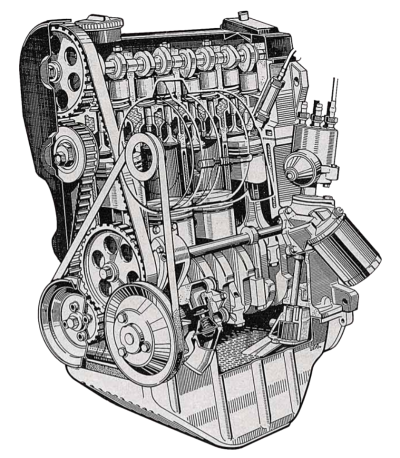 The engine is a 1.7-liter, 4-cylinder gasoline engine.
It is based on the familiar 1.6-liter engine.
The larger displacement was achieved through a modified crankshaft.
A finned, lightweight aluminum oil pan is installed for improved cooling.
A standard steel plate underneath protects the engine from damage.
Data
| Displacement | 1,714 cm³ |
| Bore | 79.5 mm Ø |
| Stroke | 86.4 mm |
| Power | 55 kW at 5,500 l/min |
| Torque | 135 Nm at 2,800 l/min |
| Octane rating | 90 RON min. |
Carburetor
 The I-B-I is a single-stage downdraft carburetor.
The housing is made of light alloy.
The jet arrangement is insensitive to vehicle tilt.
This is new
 Thermochoke
 Vacuum-controlled part-load enrichment
Main Components


Carburetor Top

Carburetor Bottom

Function

(1) Cold Start
During a cold start, the mixture is additionally enriched via
- part-load enrichment and
- full-load enrichment
Once the engine has started, the part-load enrichment is deactivated.
A sufficiently rich mixture is supplied by the mixture outlet arm, the transition ports, and the full-load enrichment.
The eccentric mounting of the air flap and the pulldown device counteract an over-rich mixture.
 Additional Mixture
The additional fuel-air jet supplies an additional mixture to the base mixture.
The idle speed screw is used to adjust the mixture quantity and thus the idle speed.
(3) Part-load operation
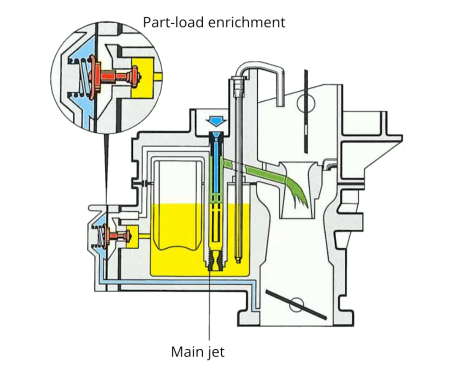
The main jet limits the amount of fuel supplied for economical part-load operation with favorable emissions.
Part-load enrichment is vacuum-controlled.
When sufficient vacuum is present, the diaphragm closes the enrichment valve.
If the vacuum is insufficient, a spring opens the part-load valve.

(5) Full-load
In addition to the part-load enrichment, the mixture is enriched via a dip tube.
Accelerator Pump
 Additional fuel is required during acceleration.
At full load, the pump does not enrich the fuel mixture because the vacuum is insufficient to open the spring-loaded pressure valve.
The piston is actuated via a linkage.
During the piston's downward stroke, the pressure valve opens, and fuel is injected.
During the upward stroke, the suction valve opens, and the pump chamber fills with fuel.
 The amount of fuel injected by the accelerator pump can be adjusted by changing the cam.
Thermochoke
The thermochoke is an improvement on the previous choke.
Incorrect operation is impossible, as the air flap cannot close when the engine is warm.
The thermochoke is not externally heated; the position of the air flap is determined by the ambient temperature.

Engine Cold
The choke is engaged.
The air flap is closed by the bimetallic spring.
The throttle valve is slightly opened.

Warm-up Phase
As the ambient temperature rises, the bimetallic spring extends and opens the air flap.

Engine Warm
Once operating temperature is reached, the choke must be pushed back, otherwise the idle speed will be too high.
Cold Idle
For a smooth idle of the cold engine, the throttle valve is slightly opened.
The position of the throttle valve, and thus the cold idle speed, is determined by the cam.
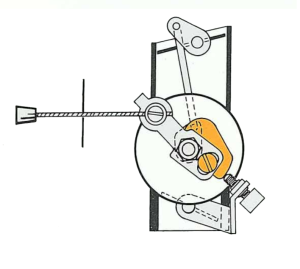
Cold Engine
The throttle valve is slightly opened by the cam.
The engine has an increased idle speed.
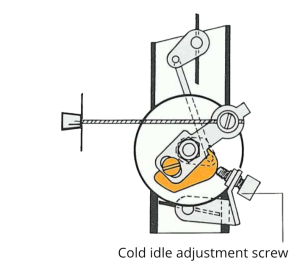
Warm Engine
The air flap has been opened by the thermochoke.
Pushing the choke back closes the throttle valve.
The engine is running at the specified idle speed.
Intake Air Preheating
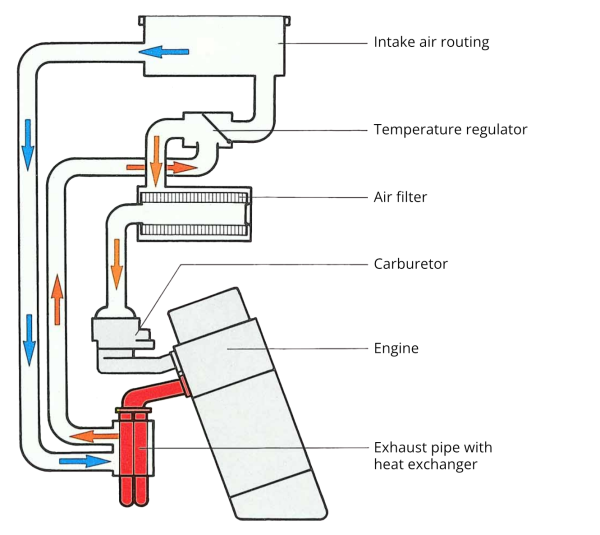
To prevent water from entering the intake air during water crossings, the intake air preheating system is fully enclosed.
 |  |
|
| Intake air temperature is below 25°C The intake air temperature is too low. The temperature regulator blocks direct access of outside air to the carburetor. All intake air is routed to the carburetor via the heat exchanger on the exhaust pipe. | Intake air temperature is above 25°C The intake air is heated. No further temperature increase is necessary, therefore cold air is mixed in via the temperature regulator. If the outside air temperature rises, the intake air is no longer preheated. |
Power Transmission
Gear Ratios
| Off-road gear | 7.6 |
| 1st gear | 3.9 |
| 2nd gear | 2.3 |
| 3rd gear | 1.5 |
| 4th gear | 1.1 |
| Reverse gear | 7.3 |
| Final drive | 5.3 |
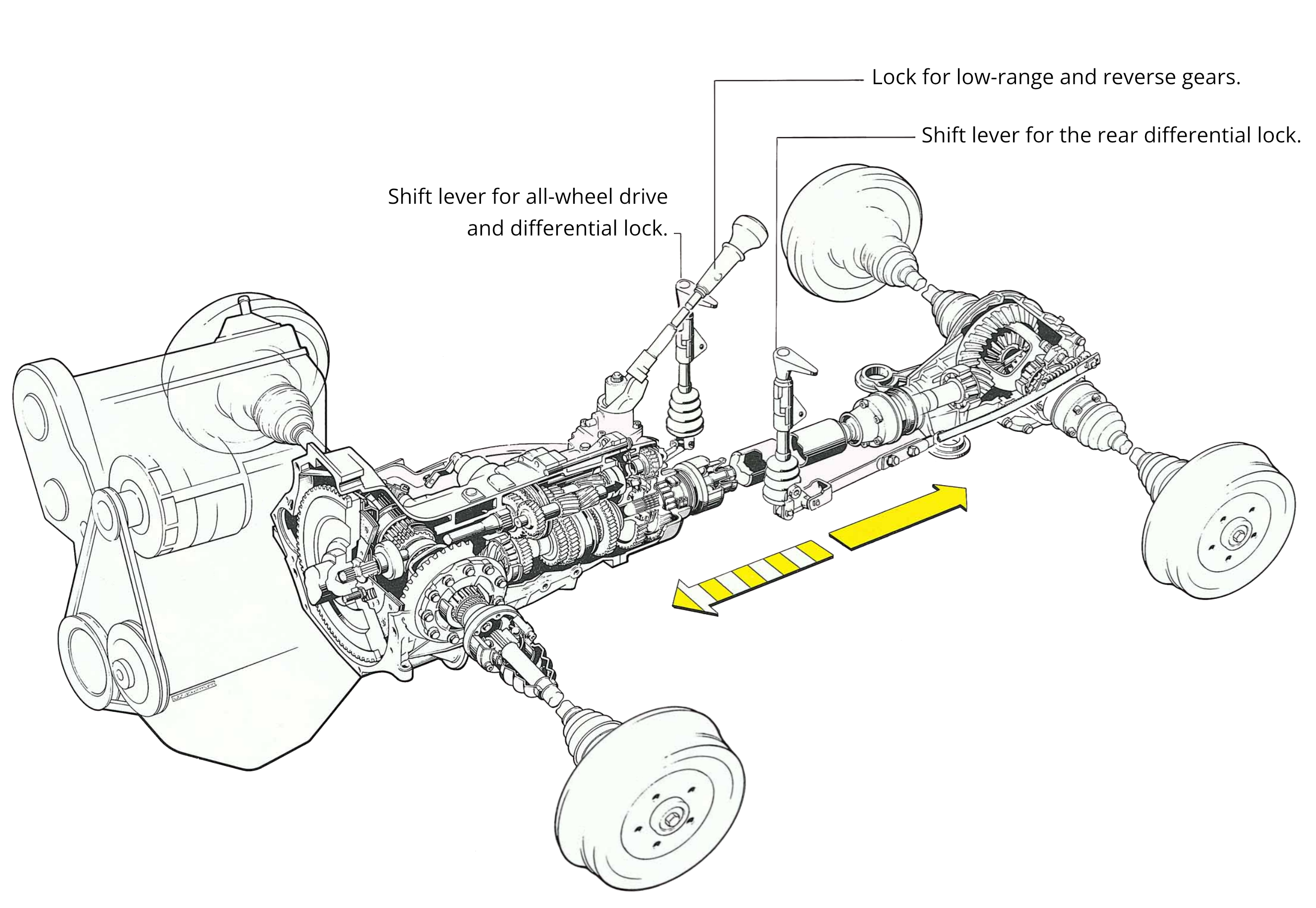
The ILTIS comes standard with all-wheel drive and a low-range gear.
Normally, power is delivered to the rear axle.
Front-wheel drive can be engaged when needed.
The transmission has five forward gears.
One of these is a low-range gear for difficult terrain.
The low-range and reverse gears are not synchronized.
Selectable differential locks for the front and rear axles are available as optional equipment.
Transmission
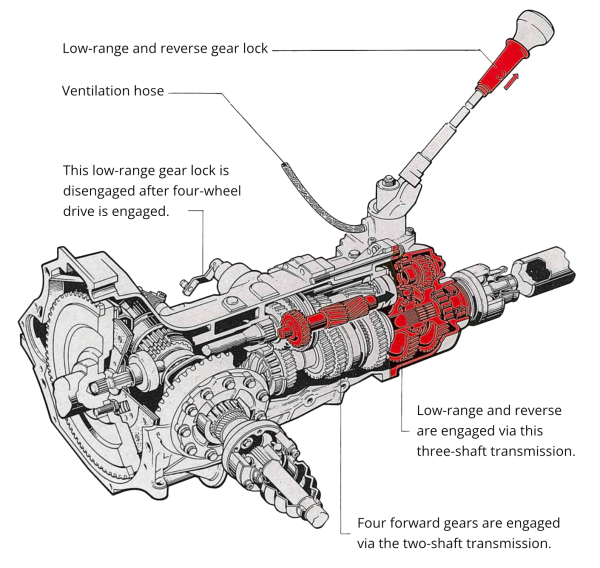
The familiar 088 transmission has been enhanced with a layshaft for low-range and reverse gears.
Low-range gear can only be engaged when four-wheel drive is activated.
Low-range/Reverse Gear

Low-range Gear
Low-range gear provides a significant increase in traction.
The torque of the input shaft is amplified a second time via the layshaft.
To prevent the output shaft from changing direction, an intermediate gear is located between the layshaft and the output shaft.
The sliding sleeve connects the low-range gear selector to the output shaft.

Reverse Gear
For reverse gear, the direction of rotation of the output shaft must be reversed.
The layshaft achieves this reversal of direction and the corresponding reverse gear ratio.
The sliding sleeve then connects the reverse gear selector to the output shaft.
All-Wheel Drive with Front-Wheel Drive and Differential Lock
All-wheel drive is engaged by switching on the front-wheel drive.
A differential lock can be installed as an optional extra.
All-wheel drive and the differential lock can be engaged while driving.
The engaged differential lock increases tire wear and should be disengaged under normal road conditions.

The right-hand drive shaft is a two-piece design.
It consists of the drive flange and the axle shaft.
No drive power is transmitted when disengaged.

 |  |
|
| Four-wheel drive engaged The shift lever rotates the shift shaft via a linkage. The shift fork moves the sliding sleeve through spiral grooves. The drive flange and axle shaft are positively engaged. The drive power is transmitted. Simultaneously, the lock for off-road gear is disengaged. | Differential lock engaged A drive wheel spinning results in a loss of drive power. A differential lock prevents this disadvantage. The shift lever moves the sliding sleeve far enough that the differential housing is positively engaged with the drive flange. The differential is locked. |
Rear-axle Drive Differential Lock
A differential lock, which can be engaged while driving, can be installed as an optional extra for the rear-axle drive.

The components of the front and rear axle differential locks are essentially identical. Their function is the same.

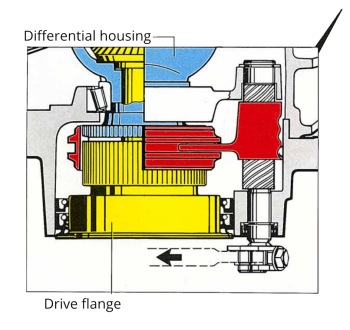 | Differential lock engaged The drive flange and differential housing are positively connected. The differential is locked. |
Drive Options
The standard transmission allows for the following drive options.
 |  |
|
| Rear-wheel drive Power is transmitted only to the rear axle and is sufficient for normal road conditions. | All-wheel drive Front-wheel drive can be engaged in difficult terrain. Off-road mode can only be engaged in conjunction with all-wheel drive. |
Further options are available when using the optional extras.
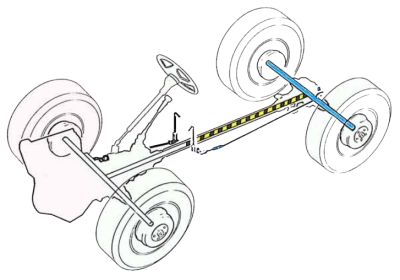 |  |  |
||
| Rear-wheel drive with differential lock The differential is locked. Wheel spin on the rear axle is prevented in adverse ground conditions. | All-wheel drive with rear differential lock In addition to the rear-wheel drive with locked differential, the front-wheel drive is engaged. | All-wheel drive with differential lock front and rear Both differentials are locked. This shift option should only be used in the most difficult terrain. When cornering, all drive wheels roll on different circular paths at the same speeds. Increased wear and difficult steering are associated with this. |
Chassis
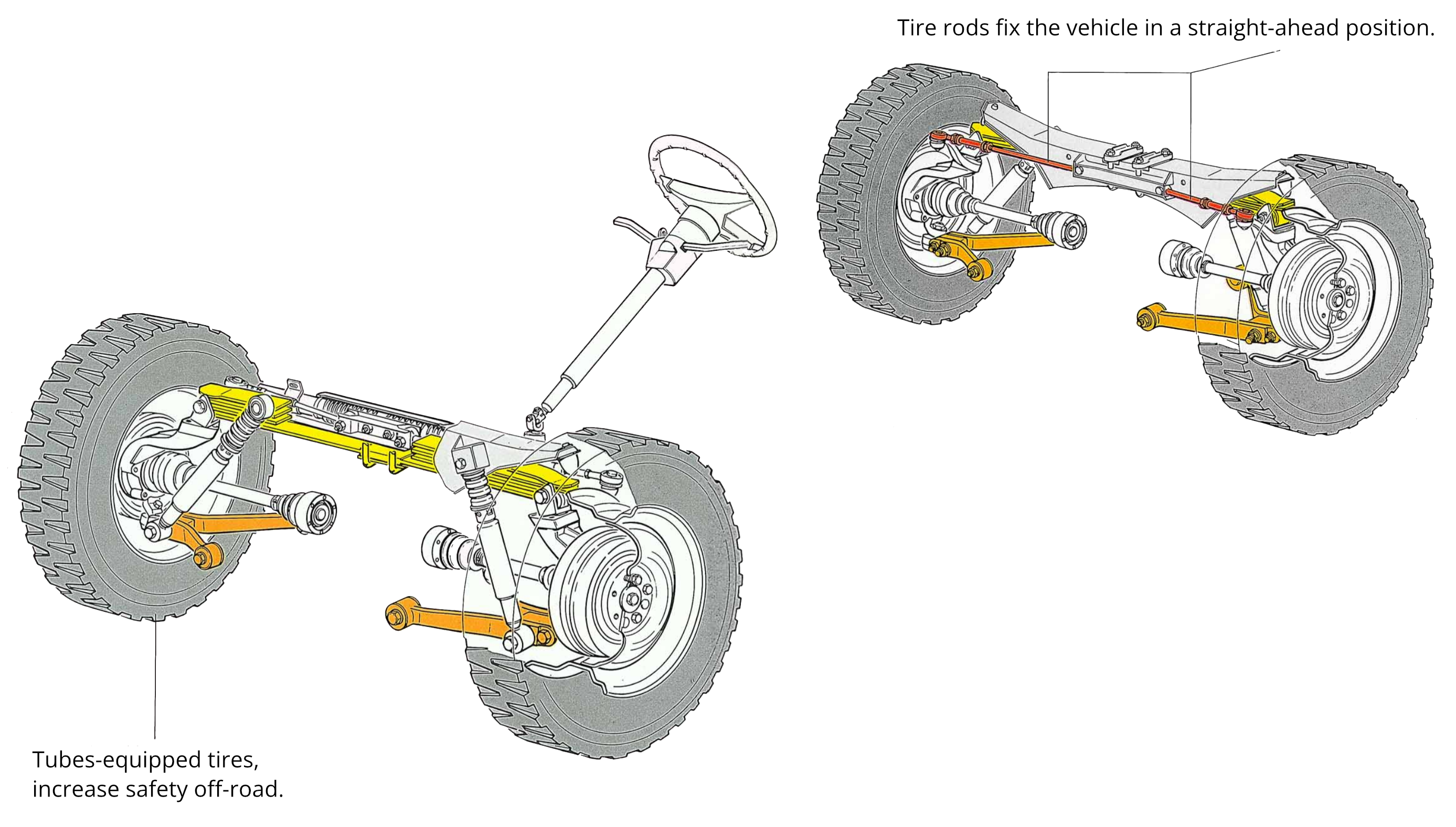
The front and rear axles are identical.
The braking system differs.
Duplex brakes at the front and simplex brakes at the rear.
The front wheels are steered by a rack and pinion system.
The rear wheels are fixed in a straight-ahead position by tie rods.
Toe-in is adjustable.
Camber is not adjustable.
Wheel Suspension
All wheels are independently suspended.
Wheel guidance is provided by a collapsible wishbone at the bottom and a leaf spring at the top.
The leaf spring is collapsible, and the spring leaves can be replaced individually.
Unlike a coil spring, if a leaf breaks, the entire spring does not fail.
For safety reasons, two spring eyes provide upper wheel guidance.

Steering
The ILTIS is equipped with rack and pinion steering.
The angled steering column and the impact-absorbing steering wheel hub enhance safety.
The rack and pinion steering is adjustable.
The steering damper is standard.

Bodywork
The body and chassis are separate assemblies.
The body is attached to the chassis with bolted connections.
Parts of the chassis that are vulnerable in an accident, such as the front and rear crossmembers, as well as the essential body components, are available as spare parts.

Questions
| 1. | The ILTIS is equipped with a low-range gear and four-wheel drive as standard. Decide which operation is correct. | ||
| A | The low-range gear can be engaged independently of the four-wheel drive. | ||
| B | The low-range gear can only be engaged in conjunction with the four-wheel drive. | ||
| C | The four-wheel drive can be engaged independently of the other gears. | ||
| 2. | Check the diagram that shows the power flow for the low-range gear. | ||
| A |  |
||
| B | 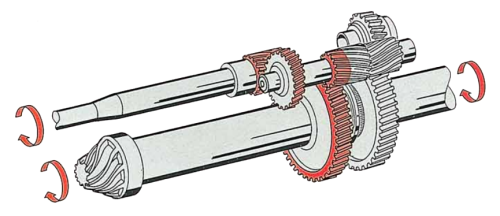 |
||
| 3. | After a repair, the thermochoke was reassembled as shown here. |  |
|
| A | The assembly is correct | ||
| B | The assembly is incorrect | ||
| 4. | The diaphragm of the part-load enrichment valve is leaking. What happens? |  |
|
| A | The valve does not close. Fuel is drawn off through the vacuum channel. The idle and lower part-load ranges are heavily enriched. This leads to increased fuel consumption. |
||
| B | The valve does not open because the vacuum is insufficient. | ||
| 5. | The hose has come loose at the marked location. What could be the consequences? |  |
|
| A | The intake air is not filtered. | ||
| B | The intake air is not preheated. | ||
| C | When driving through water, the engine may draw in water. | ||
| 6. | A differential lock is available as an optional extra for the ILTIS. Which statement is correct? | ||
| A | When the differential lock is engaged, the differential is inoperative. | ||
| B | When the differential lock is disengaged, no drive power is transmitted under normal ground conditions. | ||
| C | A permanently engaged differential lock increases tire wear. | ||
Solutions
- B and C
Four-wheel drive must be engaged first.
Only then can low-range gear be engaged.
- A is correct
- B
The rocker arm (orange) is installed incorrectly.
In this position, the bimetallic spring cannot open the air flap when the engine is warm. The correct installation position is shown on page 12.
- A is correct
- B and C are correct
- A and C are correct
[Back Cover]
These self-study programs have been published so far:
Learn About the Passat's Technology.
The Engine. The Heating System. The Transmission.
The Axles. The Brakes. The Steering.
The Carburetor. The Electrical System. The Bodywork.
The Technology of the L-Jetronic.
The Scirocco.
The Golf.
The Audi 50.
Automatic Transmission for Volkswagen and Audi.
The Polo.
The LT.
The K-Jetronic.
The LT-Diesel Engine.
Audi 100/77.
VW Diesel Engine 1.5 1
Power Steering.
Audi 100/5E.
Controlling the Heating and Air Conditioning in the Audi 100.
Level Control in the Audi 100.
Air Conditioning in the Audi 100.
5-Cylinder Diesel Engine.
Cruise Control in the Audi 100.
LT 40/45 6-Cylinder Diesel Engine.
5-speed Manual Transmission 020.
The New Transporter.
Transistor Ignition System with Idle Stabilization.
Sunroofs.
5-speed Manual Transmission 016.
For internal use only within the V.A.G. organization.
September 1979 Volkswagenwerk Aktiengesellschaft Wolfsburg.
© All rights reserved. Technical specifications subject to change.
900/280.839.00