
1981 · OFF-ROAD · Polecat Power: Volkswagen's Iltis
January 19814 Pages
Polecat Power: Volkswagen's Iltis
VW's new military 4×4 Wunder-Wagen digs into the sporting world
Photos by the Author and Courtesy of Volkswagen
By Richard Laurence

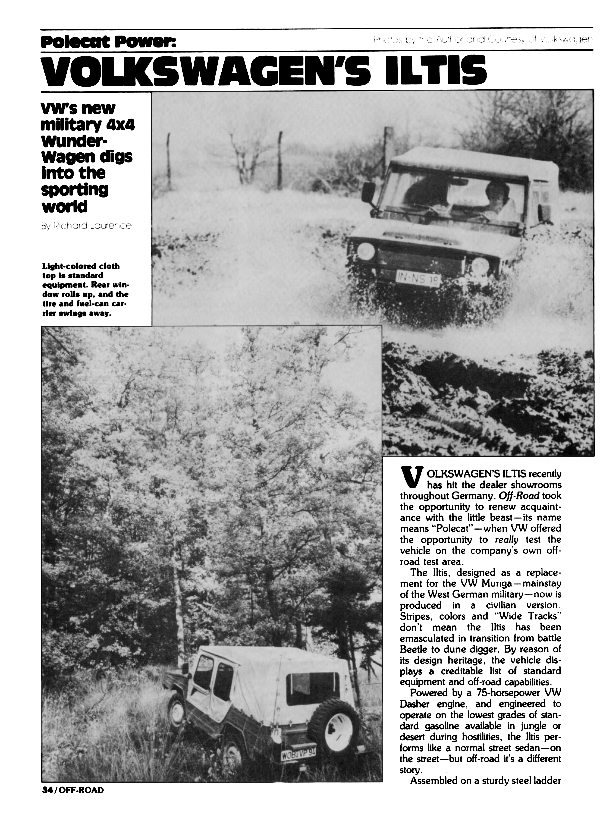
Light-colored cloth top is standard equipment. Rear Window rolls up, and the tire and fuel-can carrier swings away.
VOLKSWAGEN'S ILTIS recently has hit the dealer showrooms throughout Germany. Off-Road took the opportunity to renew acquaintance with the little beast—its name means “Polecat”—when VW offered the opportunity to really test the vehicle on the company’s own offroad test area.
The Iltis, designed as a replacement for the VW Munga—mainstay of the West German military—now is produced in a civilian version. Stripes, colors and “Wide Tracks” don’t mean the Iltis has been emasculated in transition from battle Beetle to dune digger. By reason of its design heritage, the vehicle displays a creditable list of standard equipment and off-road capabilities.
Powered by a 75-horsepower VW Dasher engine. and engineered to operate on the lowest grades of standard gasoline available in jungle or desert during hostilities, the Iltis performs like a normal street sedan—on the street—but off-road it’s a different story.
Assembled on a sturdy steel ladder frame, with a stamped steel bathtub body, the Iltis offers’ immense strength with just enough torsional flex to keep all the wheels on the ground and working. Body seams are not just resistance spot welded: long strip beads are in evidence throughout the exposed parts of the vehicle's interior.
The Iltis powertrain starts with the Dasher engine coupled to an ingenious gearbox designed by Audi. The transmission is interesting because front wheel driveshafts exit just behind the clutch housing, while the gearsets do their work at the extreme rear of the case. This configuration permits elimination of the conventional transfer case from its traditional location halfway along the rear driveshaft. Instead, transfer gears are grouped in the main transmission housing, and the driveshaft is a straight, one-piece unit extending all the way to the rear differential. This means that power lost through driveline resistance and multiple U-joints is held to a minimum, which improves fuel consumption and eases maintenance.
The Iltis’ wheel suspension is independent with double wishbones front and rear. Shock absorbers are telescopic and damp the action of transverse semi-elliptical springs which are mounted on subframes. To reduce spare parts requirements and to make field maintenance less complex, each complete driveshaft/hub/wheel assembly is interchangeable with the other three. And, the Iltis features rack-and-pinion steering.

Phantom drawing shows front-drive and 4WD systems, double wishbones at all four wheels and location of tranverse leaf springs.
Military vehicles aren't designed to be beautiful—and the Iltis certainly isn't. VW stylists, however, have redeemed the situation somewhat with installation of wide tires, fender flares, stripes and a nifty fiberglass top. Standard weather protection is a light-colored ragtop that conceals a heavy tubular steel rollbar.
At the rear, spare tire and wheel, plus a five-gallon jerrycan, swing away on a separate gate. The rear of the fiberglass top, if one is installed, lifts and is secured by a separate prop. The cloth top rear window rolls up and is secured in place with straps.
The Iltis displays sufficient underhood space for all mechanicals—and a spade for those unfortunates who bury the Polecat is strapped to the underside of the hood.
Inside, the Iltis is relatively luxurious, at least in comparison with the majority of other 4x4s. The seats are from the Audi Fox, and are cloth upholstered. Brake, clutch and throttle pedal positions are just right, even for six-footers. The gear lever is easy to reach and operate.
A large instrument cluster faces the driver and is dominated by a speedometer the size of a Frisbee. Directional indicators and windshield wipers are operated by stalks on either side of the heavily padded steering wheel, and come directly from the VW Rabbit parts shelf.
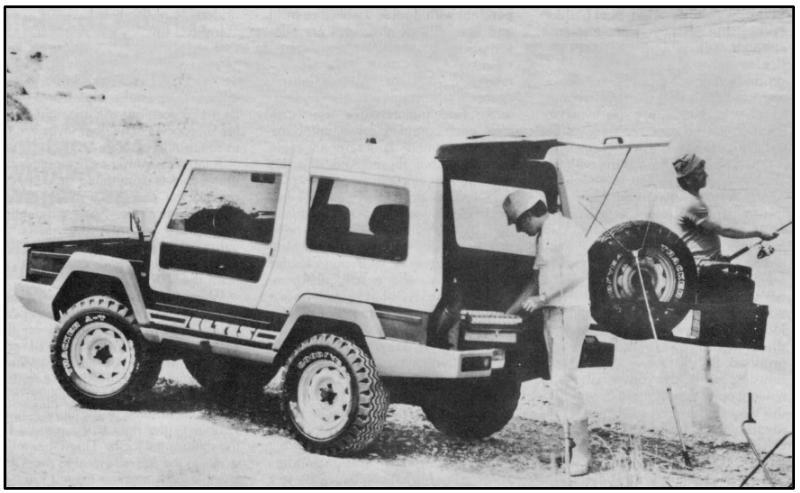
Civilian version of the battle Beetle features optional fiberglass top, stripes and wide-track tires.
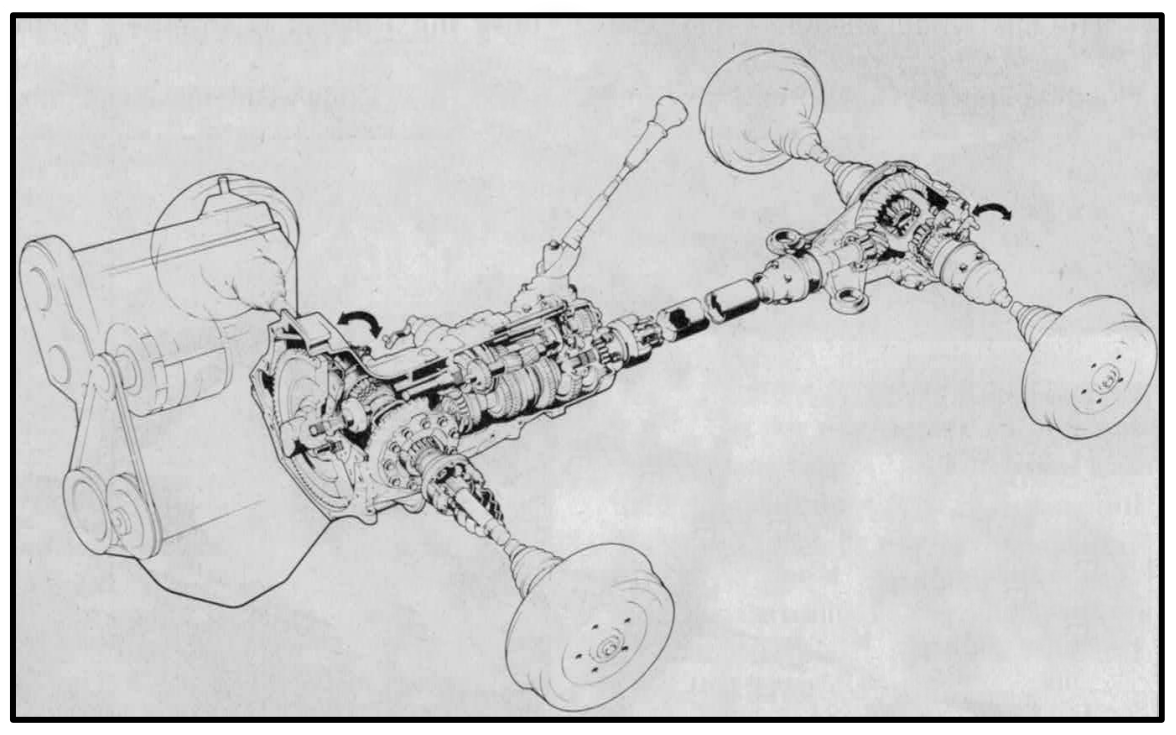
Iltis transmission/transfer gearing is located behind the dry-plate clutch and front-drive differential. Axle shafts are interchangeable.
When the off-road situation deteriorates sufficiently, the Iltis driver can resort to two levers located on the vehicle’s floor just forward of and between the driver and passenger bucket seats. On the left is the control for 4WD engagement. Operation is by a lift-and-twist-to-the-right action. Farther to the right is the handle for the differential locks. This T-bar lever works in the way identical to the 4WD lever, except that the twist is once to the right for rear lock, and one more twist to the right to lock-up the front-drive wheels. Both controls can be operated while the Iltis is rolling.
And driving an Iltis is really fun! At VW's factory in Wolfsburg, Germany, two vehicles were available for driving. The first was the beat-up, test-to-destruction factory unit, and the second was a dolled-up civilian version with no miles showing on its odometer. The first was for performance testing, the second was for photos.
On VW’s test course, sand is the major ingredient, hence the widetired civvy Iltis would have been better suited to off-pavement conditions. However, the weary military model with narrow tire treads refused to stick itself in the sand. With engine whining at high rpm, the Polecat was aimed at the nearest steep slope in four-wheel drive, anticipating that half-way up the hill, those narrow treads would dig their own graves. Surprise! The Iltis scooted up the incline like a World War II half-track. In fact, the vehicle shot up the hill so fast, it was necessary to apply brakes to avoid becoming airborne at the crest of the rise. On the level again, the Iltis flew through hub-deep sand.
Because of its short wheelbase, the Iltis is not the most comfortable of vehicles, but neither is a CJ-5. The Polecat’s standard front skidplate, mounted beneath lower engine vitals, is really necessary in rough terrain running. The best way to maneuver an Iltis around outcrops and sharp turns is to drive into the corner as far as possible, crank the steering over, then back off the power. This technique works best because power stays longer at the front axle than at the rear; it’s fractional, but it works well.
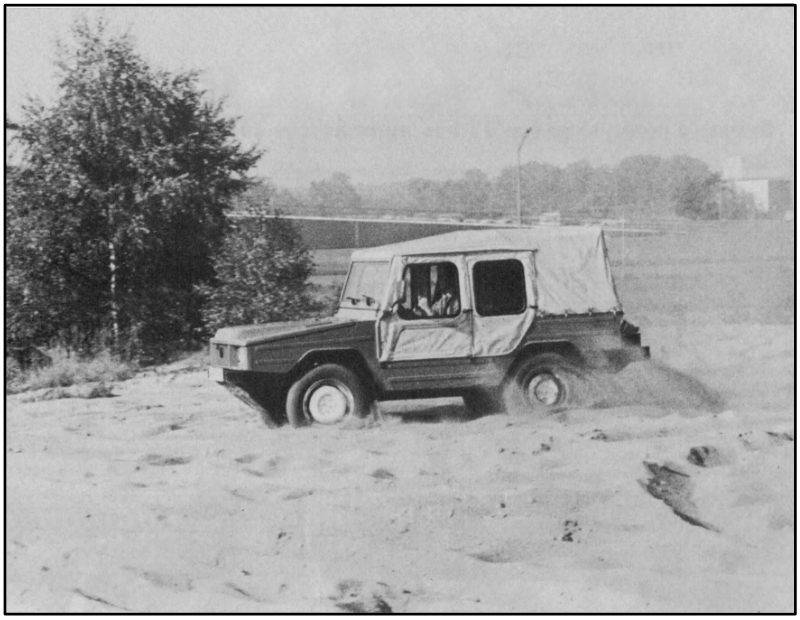
In VW's sandy test course, the Iltis displays full low-range, lock-up traction.
On the steepest slope on the course, the Iltis was at last stopped by sand. Hanging on the side of a 60-degree incline can give any driver prickles at the back of the neck. This evolution didn’t bother the Iltis, though. Compound low gear was selected, both front and rear differentials were twisted into full lock, and the Polecat powered its way to the top of the hill as thought it were on asphalt.
Note: The Iltis’ steering is highly responsive, so long as the driver keeps his thumbs out of the way. The learning experience here resulted in a very sore thumb.
The Iltis offers a maximum load capacity of about 1500 pounds and will tow a 2000-pound trailer.
Out on the road, the Polecat progressed at a maximum speed of 75 mph. Its zero-to-60-mph time was tallied at a respectable 21 seconds. At highway speed, though, the ragtop slapped against bodysides in an irritating way.
All of the above is the good news. Now for the bad news: The Iltis is not yet earmarked for either sale or production in the U.S., mainly because of the cost to Volkswagen of bringing the vehicle up to federal emissions and safety standards. This is truly disappointing because the Iltis offers advanced 4WD technology, excellent highway performance, high fuel economy, and mountain goat-like attributes that would be welcomed by U.S. off-roaders—even those to whom “Polecat” is a fightin’ word.
Iltis Technical Data
Engine
Typehorizontally opposed, watercooled, in-line four-cylinder
Bore x stroke, in.3.13 x 3.40
Piston displacement, CID (cc)104.6 (1714)
Compression ratio8.2:1
Horsepower @ rpm75 @ 5000
Torque @ rpm, lb-ft96 @ 2800
Carburetorsingle
Electricals:
Starter/alternator, V12
Battery, V/ah12/45
Drivetrain
Transmission:
Clutchsingle-plate, dry, diaphragm spring
Gearboxfour-speed, synchro, low range coupled to 4WD
Ratios:
Compound low7.603:1
1st3.909:1
2nd2.278:1
3rd1.458:1
4th1.086:1
Final drive5.286:1
Four-wheel drive:
Engagementlever, vehicle under way
Body/Chassis
Suspension:
Frontindependent with double wishbones, ball joints, multi-leaf semielliptical leaf springs, hydraulic shock absorbers
Rearindependent with double wishbones, semi-elliptical leaf springs, hydraulic shock absorbers
Brakes:
Front/rear11-inch drums
Hydraulicsdual-diagonal circuitry
Dimensions
Wheelbase, in.79.4
Overall length, in.156.4
Overall width, in.59.8
Overall height, in.72.3
Track, front/rear, in.48.5/49.6
Turning diameter, ft.36.1
Ground clearance, in.8.9
Approach angle, degrees42
Departure angle, degrees33
Weights
Maximum load space, cu. ft.67
Curb weight, pounds2866
Gross vehicle weight, pounds4409
Payload, pounds1543
Performance
Top speed, mph81
Acceleration:
0-50 mph, seconds11.5
0-60 mph, seconds21.0
Fuel Use
Requirement, octane minimum91
Mpg, highway, 55 mph22.5
Mpg, highway, 75 mph15.4
Mpg, average, city/highway17.4