
1997-10-25 Ch 221,999KB
C-30-108-000/MB-000
Operator's Manual
Truck Utility, Light 4 x 4 Military Design Iltis Canadian Series
Issued on Authority of the Chief of the Defence Staff
OPI: DSVPM
1985-7-15
1997-10-25 Ch 2
Part 1 — General Descripton
Section 1 — General
Scope
1.This manual contains operating instructions for the Truck, Utility, Light, 4×4, Military Design, litis Canadian Series. The manual also includes maintenance instructions at an operator's level.
Intended Use
2.The manual provides the operator with the necessary information for safe and trouble-free operation of the truck.
Authority
3.All correspondence concerning this manual should be directed to:
National Defence Headquarters
Ottawa, Canada
K1A OK2
Attention: DSVPM 3
Section 2 — Description
Vehicle Configuration
1.The Light Utility Trucks are divided into the following configurations:
| ECC | Description | |
|---|---|---|
| a. | 121501 | Truck, Utility, Light, 4×4, Military Design, litis Canadian, Basic |
| b. | 121503 | Truck, Utility, Light, 4×4, Military Design, litis Canadian, with Ambulance Kit |
| c. | 121508 | Truck, Utility, Light, 4×4, Military Design, IItis Canadian, w/Cable Laying Kit |
| d. | 121511 | Truck, Utility, Light, 4×4, Military Design, Iitis Canadian, w/Tow System Launcher Kit |
| e. | 121512 | Truck, Utility, Light, 4×4, Military Design, Iltis Canadian, w/Tow Missile Carrier Kit |
| f. | 121513 | Truck, Utility, Light, 4×4, Military Design, Iitis Canadian, with 100 Ampere Alternator |
| g. | 121519 | Truck, Utility, Light, 4×4, Military Design, Iltis Canadian, w/Tailgate |
| h. | 121527 | Truck, Utility, Light, 4×4, Military Design, Iltis Canadian, with Military Police Kit |

Figure 1-2-1 — Truck, Utility, Light 4 x 4, Military Design,
Iltis Canadian, Basic
2.The Light Utility series of trucks is designed for use over all types of road, cross-crountry terrain, and all weather conditions. The truck will ford hard bottom bodies of water, to a depth of 60 cm (23.6 in.) without special fording equipment. Figure 1-2-1 illustrates the Basic Light Utility Truck.
3.Trucks are powered by a 4-cylinder 1.7 litre gasoline engine. A five-speed manual transmission which includes a cross-country gear, is coupled to the front and rear differentials which in turn direct power to the front and rear wheels.
4.Single wheels are fitted to both the front and rear axles.
5.This vehicle has two separate brake systems:
- Service brakes - Operates through a hydraulic cylinder which transmits hydraulic pressure to the wheel cylinders. The service brake system is a diagonal dual type brake system.
- Hand-Brake - The hand brake is operated by a lever connected by cable to the rear brake system.
6.The Light Utility Trucks are equipped with electrical connectors and pintle hooks, making them suitable for towing trailers.
7.The trucks are equipped with removable, canvas-covered superstructures which provide all-weather protection for the driver and passengers. Four separate doors are removable.
8.A spare wheel assembly (tire and rim) mounted on the rear of the body, provides an emergency spare wheel assembly change for vehicle or trailer.
Vehicle Data
9.Figures 1-2-2, 1-2-3, 1-2-4, 1-2-5, 1-2-6, and 1-2-7 contain, in tabular form, data of the basic truck series.
| Weights (kg) without crew Maximum capacity |
||||
|---|---|---|---|---|
| Vehicle configuration | Description | Curb weight | Cross-country | Highway |
| Basic | Payload | *365 kg | 500 kg | |
| Front Axle | 705 kg | - | 1,000 kg | |
| Rear Axle | 730 kg | - | 1,250 kg | |
| Total Weight | 1,435 kg | 1,800 kg | 2,050 kg | |
| Maximum Towed Load | 482 kg | 595 kg | ||
| Shipping Volume (m) | 11 m | 11 m | 11 m | |
* Weight placed over rear axle Figure 1-2-2 — Weights and Loads
| Description | Dimensions |
|---|---|
| Overall Length | 3,974 mm |
| Overall Width | 1,520 mm |
| Height | 1,837 mm |
| Wheelbase | 2,017 mm |
| Angle of Approach | 41 degrees |
| Angle of Departure | 32.50 degrees |
| Ground Clearance (under axles) (under chassis) | 250 mm 330 mm |
| Turning Radius: - Right turn - Left turn | 5.5 m 5.5 m |
Figure 1-2-3 — Dimension Data
| Description | Capacity |
|---|---|
| Cooling system | 7.5 Litres |
| Crankcase (without filter) (with filter) | 4.0 Litres 4.5 Litres |
| Windshield washer | 1.7 Litres |
| Gasoline Tank | 82 Litres |
| Transaxle | 3.6 Litres |
| Rear Differential | 1.6 Litres |
Figure 1-2-4 — Capacities
| Transmission gear selection | Speed |
|---|---|
| 1st Gear | 0-40 km/h |
| 2nd Gear | 20-70 km/h |
| 3rd Gear | 30-105 km/h |
| 4th Gear | 40-130 km/h |
| Reverse | 0-20 km/h |
| Cross-Country | 0-20 km/h |
Figure 1-2-5 — Maximum Permissible Speeds for Run-In Vehicle
| Performance factor | Without towed load | With towed load |
|---|---|---|
| Maximum Speed | 130 km/h | 115 km/h |
| Maximum Grade | 60.9 degrees | 45 degrees |
| Cruising Range | 700 km | 500 km |
Figure 1-2-6 — Performance at Gross Weight
| Tire Size | 6.50 R 16 (Michelin XC Type L) |
| Tire pressure (cold) | ||||
|---|---|---|---|---|
| Front | Rear | |||
| Operating conditions | kPA | psi | kPa | psi |
| Highway | 250 | 36 | 300 | 44 |
| Cross-country | 250 | 36 | 300 | 44 |
| Mud, Sand, Snow | 250 | 36 | 300 | 44 |
Figure 1-2-7 — Tire Size and Inflation Data
Major Identification and Instruction Plates
10.Identification, instruction and precautionary plates and decals are located on the vehicle. See Figure 1-2-8 for their locations. Figure 1-2-9 illustrates these items.

Figure 1-2-8 — Location of Vehicle Identification and Instruction Plates


Figure 1-2-9 — Vehicle Identification and Instruction Plates
Part 2 — Descripton of Controls and Instruments
Section 1 — Instruments and Indicators
General
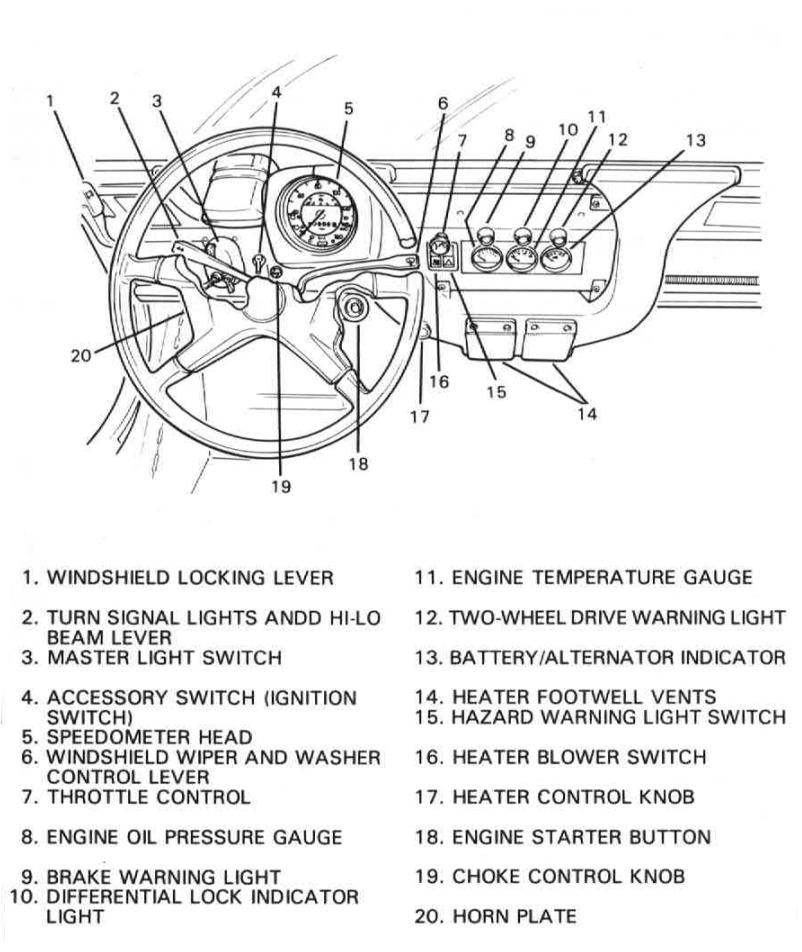
1.Figure 2-1-1 illustrates the location of vehicle gauges, instruments and indicators, except those located in the speedometer head, which will be found in Figure 2-1-2. Paragraphs describing those items found in each illustration use bracketed numbers to refer to call-outs.
Engine Oil Pressure Gauge
2.This gauge, see Figure 2-1-1 (8), indicates the engine oil pressure when the engine is running. When driving, normal pressure is 200 kPa at approximately 2,000 rpm at normal operating temperature. Lower oil pressure readings are normal at idle.
Engine Temperature Gauge
3.This gauge (11) indicates the temperature of the engine coolant. Normal operating temperature is 90°C to 95°C.
Battery/Alternator Indicator
4.This gauge (13) indicates the condition of the batteries and whether the charging system is charging the batteries. When the accessory switch is turned on, the gauge indicator should be in the green zone, if the batteries are adequately charged. When the engine is running, the gauge indicator should be in the green zone, indicating that the charging system is working.
Differential Lock Iindicator Light
5.When lit, the red warning light (10) indicates that the rear differential lock is engaged.
Two-wheel Drive Warning Light
6.When lit, the amber warning light (12) indicates that the front wheel drive is disengaged. This is an abnormal driving condition. Four-wheel drive should be selected as soon as possible.
Brake Warning Light
7.The brake warning light (9) lights when the hand brake is engaged and/or when the fluid in either brake fluid reservoir is low.

Figure 2-1-2 — Speedometer Head
Speedometer Head
8.The speedometer, see Figure 2-1-2 (1), indicates the forward speed of the vehicle in kilometers per hour. The odometer, (10) in the lower centre of the speedometer, indicates the total kilometers travelled by the vehicle up to six digits.
Gasoline Gauge
9.When the accessory switch is on, the gasoline gauge (2) indicates the approximate quantity of gasoline in the gasoline tank. The tank holds 82 litres. When the needle reaches the beginning of the reserve zone, there are about 10 litres of gasoline in the tank.
Oil Pressure Warning Light
10.The oil pressure warning light (5) will light when the oil pressure drops below 45 kPa indicating that the oil pressure is below operating level. The red warning light will light when the accessory switch is turned on and should go out as the engine starts. If the light comes on while driving, immediately stop and check the engine oil level (refer to Part 7, Section 3, "Operator Maintenance Instructions" and Part 7, Sections 5, "Troubleshooting").
Battery/Alternator Warning Light
11.The battery/alternator warning light (7) shows red if the alternator is not providing current to the vehicle electrical system. If this occurs, stop the engine and check the drive belts. Do not drive without a drive belt as the alternator and coolant pump are not being driven.
Engine Temperature Warning Light
12.The red warning light (8) will light at 120°C to indicate that the engine temperature is too high. When driving at slow speed for extended periods during hot weather, excessive engine speed may cause overheating. Shift up to the next higher gear if this can be done without lugging the engine and without using full throttle. If not, reduce engine speed. If the light does not go out shortly afterwards, park the vehicle and allow engine to cool at a fast idle (refer to Part 7, Section 3, "Operator Maintenance Instructions" and Part 7, Sections 5, "Troubleshooting").
Engine Oil Temperature Warning Light
13.The engine oil temperature warning light (9) will light when the engine oil temperature is too high. High oil temperature is caused by excessive engine coolant temperature (see paragraph 12) and excessive engine load. Reduce engine load by working the vehicle less hard. If the light does not go out very shortly afterwards, park vehicle and allow engine to cool at a fast idle until the light goes out, then stop engine and check oil level (refer to Part 7, Section 3, "Operator Maintenance Instructions" and Part 7, Sections 5, "Troubleshooting").
Directional Turn Signal Indicator Light
14.When flashing, the green light (6) indicates that one of the following lighting systems is in operation:
- Right turn signal
- Left turn signal.
The directional turn signal indicator is engaged by the turn signal lever.
Trailer Turn Signal Indicator Light
15.The green light (4) when lit, indicates that the trailer turning signals are operating correctly. When there is not a trailer in tow, the indicator light will flash once when the turn signals are engaged.
High Beam Indicator Light
16.When lit, the blue light (3) indicates the headlight high beams are on.
Section 2 — Hand Controls
Master Light Switch

Figure 2-2-1 — Master Light Switch
1.The master light switch assembly (3), see Figure 2-1-1, is composed of the following:
- Unlock Lever- When in the lock position, the lever prevents the driver from turning on any lights except the blackout markers. When held in the “UNLOCK” position, it allows the service lighting systems to be engaged. (Figure 2-2-1 shows all the positions of the master light switch.)
- Main Switch Lever - May be used in the following positions:
(1) BLACKOUT DRIVE - Iiluminates the blackout drive light and the front and rear blackout marker lights.
(2) BLACKOUT MARKER - Illuminates front and rear blackout marker lights only.
NOTE — When the main switch lever is in “B.O. DRIVE” or “B.O. MARKER” position, the blackout stoplights will illuminate when the brake pedal is depressed.
(3) OFF - When the main switch lever is in the “OFF” position, no lights will illuminate.
(4) STOPLIGHT - Allows the service drive stoplight to illuminate when the brake pedal is depressed.
(5) SERVICE DRIVE - Illuminates the headlights and taillights and allows the service stoplight to illuminate when the brake pedal is depressed.
- Auxiliary Switch Lever - Has four positions:
(1) PANEL BRIGHT - Illuminates the panel lights. The panel lights can be illuminated when the main switch lever is in any position other than “OFF”.
(2) DIM - Lowers the brightness of the panel lights.
(3) OFF - All lights controlled by the auxiliary switch lever are off.
(4) PARK - Illuminates only the service park lights.
NOTE — The park lights can be used only when the main switch lever is in the “SERVICE DRIVE” position.
Turn Signal and High Beam Lever
2.The turn signal lights will not function unless the main switch lever is in either the “SERVICE DRIVE” or “STOPLIGHT” position. The turn signal lights lever (2), Figure 2-1-1, can be placed in any of four positions:
- Centre Position - off.
- Up Past the Pressure Point - activates the right turn signal lights.
- Down Past the Pressure Point - activates the left turn signal lights.
NOTE — The right and left turn signal lights are automatically cancelled when the steering wheel is turned back to the straight-ahead position.
- When the headlights are on, the high beams can be switched on by pulling the turn signal lever towards the steering wheel past the pressure point. The high beams can be flashed when the main light switch lever is in the “SERVICE DRIVE” position or the “STOPLIGHT” position. To flash high beams pull the turn signal lever towards the steering wheel to the pressure point and release the lever.
Accessory Switch
3.The accessory switch (4) has two positions; the switch lever is moved clockwise to the “ON” position and counterclockwise to the “OFF” position. The accessory switch activates the following circuits:
- Engine ignition system and vehicle electrical system.
- Instrument panel gauges and indicators.
- Starter circuit.
Engine Starter Button
4.Press the starter button (18) to crank the engine for starting. Release the button as soon as the engine starts. The button is spring loaded and returns automatically to the off position.
Windshield Wiper and Washer Control Lever
CAUTION
To prevent damage to the wiper blades and wiper motor in the winter, ensure the blades are not frozen to the glass before switching on the wipers.
5.The windshield wipers and washer work only when the accessory switch is “ON”. The control lever (6) may be used in the following positions:
- Position 1 - Wipers and washers off.
- Position 2 - Wipers slow - lift control lever up past the first pressure point.
- Position 3 - Wipers fast - lift control lever up past the second pressure point until it clicks into place.
- Position 4 - Windshield washer - to spray windshield washer fluid on the windshield, pull the control lever up towards the steering wheel and hold it in position until the desired amount of fluid has been sprayed on the windshield. Release the lever to stop the spray.
Heat Control Knob
6.The control knob labelled “TEMP” (17) controls the amount of heat inside the vehicle. When the knob is fully out, maximum heat is available. Heat is off when the control is pushed all the way in.
Heater Blower Switch
7.The heater blower switch (16) controls the flow of air through the heating system. The accessory switch must be on for the blower to operate. The lower half of the heater blower switch controls the two blower speeds:
- Slow - push down past the first pressure point.
- Fast - push down past the second pressure point.
Push the top half of the switch to turn the blower off. To defrost the windshield, ensure that both heater footwell vents (14) are closed.
Hazard Warning Light Switch
8.The hazard warning light switch (15) can be used when the main light switch lever is in the “SERVICE DRIVE” or the “STOPLIGHT” position. To turn on the hazard warning lights, press the lower half of the switch. The front and rear turn signal lights will flash. To turn off the hazard warning lights, press the top half of the switch.
Choke Control Knob
9.The choke control (19) regulates the choke when starting a cold engine. Pull out the choke control before pressing the starting button and gradually push in as the engine warms.
Horn Plate
10.The horn plate (20) is located in the centre of the steering wheel. Pressure applied anywhere to the plate will sound the horn.
Throttle Control
WARNING
To prevent injury and damage to the vehicle, do not drive with the throttle control engaged.
11.Controls the carburetor throttle. To adjust the carburetor throttle using the throttle control (7) depress the accelerator pedal to open the carburetor throttle to the desired setting. While still depressing the accelerator pedal, pull out the throttle control until it holds the carburetor throttle at the desired setting. Turn the throttle control one quarter turn clockwise to lock into position. Release the accelerator pedal. To release the throttle control, turn one quarter turn counterclockwise and push in.
Windshield Locking Lever
12.The vehicle is equipped with two quick-release windshield locking levers (1), one on each side of the dash at the bottom corners of the windshield, which lock the windshield in the upright position. To release the two fasteners from the hooks on the windshield frame, pull up on the release handles and swing the clamps free of the windshield hooks.
Heater Footwell Vents
13.Pull open the heater footwell vents (14) to direct the flow of air in the heater system downward to the footwell. The amount of air directed downward can be controlled by adjusting the vent openings; when the vents are completely closed, all air flow is directed to the windshield vent openings.
Two-wheel Drive Lever

Figure 2-2-2 — Hand Brake and Differential Levers
14.The vehicle is always operated in four-wheel drive. To disengage four-wheel drive, push the lever down. To engage four-wheel drive, pull the lever up. Four-wheel drive can be engaged and disengaged when the vehicle is in motion. The actual engagement which occurs with a slight time delay , is effected by spring pressure on the transaxle linkage. The vehicle can be driven in any gear when the four-wheel drive mode is engaged. A light on the dash will come on when the vehicle is in two-wheel drive, see Figure 2-2-2, indicating an abnormal driving condition.
Rear Differential Lock Lever
15.To engage the rear differential lock, pull up on the rear differential lock lever, see Figure 2-2-2. The vehicle may be stationary or moving forward or reverse at low speeds. Do not engage the rear differential lock at high speeds or if the rear wheels are spinning. Disengage when not required.
CAUTION
Disengage the rear differential lock immediately after the need has passed or damage to the differential or axles can result.
Hand Brake Lever
16.To apply the hand brake, see Figure 2-2-2, pull up the hand brake lever. To release, push the hand brake lever all the way down. The knurled knob, located at the end of the hand brake lever, controls the hand brake cable tension. With the brake off, turn the knob left to tighten the cable and right to slacken. The warning light will come on when the brake is applied.
CAUTION
Do not overtighten the cable as this will cause the brake shoes to drag on the brake drums when the hand brake is off.
Transmission Gear Shift Lever

Figure 2-2-3 — Transmission Shift Lever
17.The shift pattern, engraved on the knob of the transmission shift lever, see Figure 2-2-3, shows the position of the gear lever in the various gear positions. Cross-country (G) and reverse (R) gears cannot be engaged unless the collar on the shift lever is lifted. Wait a few seconds, with the clutch pedal fully depressed, before engaging reverse. The cross-country gear can be engaged only when the vehicle is in four-wheel drive. The vehicle must be completely stopped before engaging the cross-country gear.
CAUTION
Do not make a habit of resting your hand on the shift lever while driving. The pressure of your hand is transmitted to the shift forks in the transmission and can cause premature wear on the forks.